Mount Pisgah Mushroom Festival
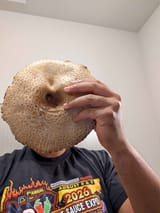
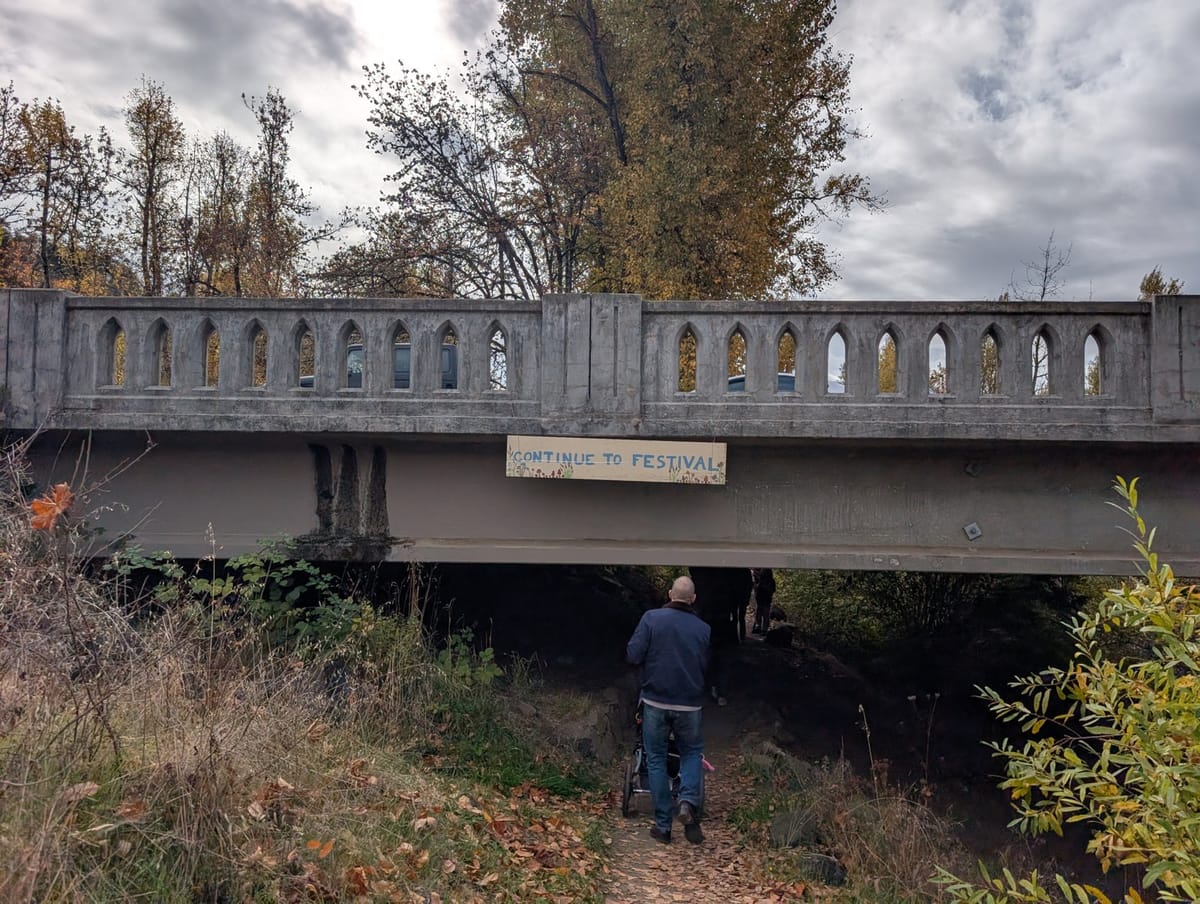
A chance encounter
Sometimes, mushrooms aren't the only thing you find while foraging... On a gorgeous early October weekend, I went collecting fungi at the coast for the fall continental MycoBlitz organized by Mycota Lab.
The Continental MycoBlitz is a time-limited survey documenting the diversity of mushrooms and other larger fungi in North America. This citizen science project is open to anyone interested in participating. Collectors upload geotagged photos and field notes to the project page on iNaturalist, while selected specimens are dried, labeled with QR codes, and mailed for scientific examination.
Mycota Lab uses DNA barcoding to help identify thousands of submissions, prioritizing well-documented, properly dried collections and rare or understudied species. Sequencing is offered without a required payment, though contributions are welcomed. Although not every collection yields a sequence, these observations establish range and seasonality. Successful sequences are shared through MycoMap and MycoBLAST and eventually deposited in GenBank. This gives citizen scientists a way to contribute records that researchers can revisit. Those records can help improve mushroom identifications and potentially reveal species new to science.
After I finished collecting mushrooms, I was about to leave and head to a different spot, but a car pulled in and out came several seasoned mushroom foragers. The group included Bruce Newhouse, Peg Boulay, Jeem Peterson, and their friend. I showed them where I found some matsutake mushrooms. Peg invited me to volunteer at the Mount Pisgah mushroom festival, and I accepted.
Mushroom display prep
The day before the festival, I helped create labels for the ID display. Volunteers from Lane Community College and the Cascade Mycological Society worked with expert mushroom identifiers like Steve Trudell. Steve wrote Mushrooms of the Pacific Northwest and coauthored Mushrooms of Alaska with Noah Siegel and Kate Mohatt. After the mushrooms were identified, volunteers stopped by a table where Arayana, Peg, and I provided labels that volunteers then placed with the mushrooms on the identification table.
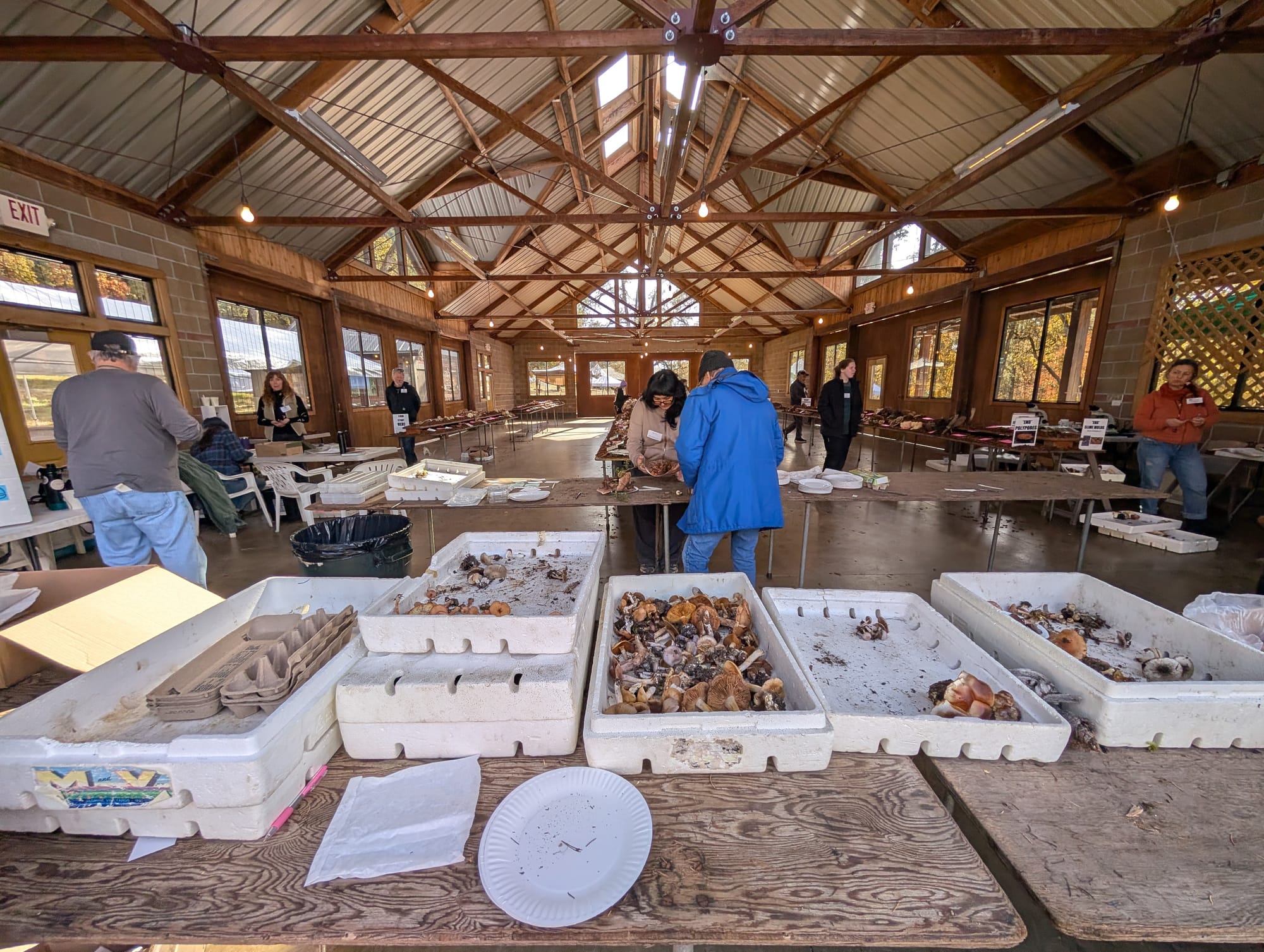
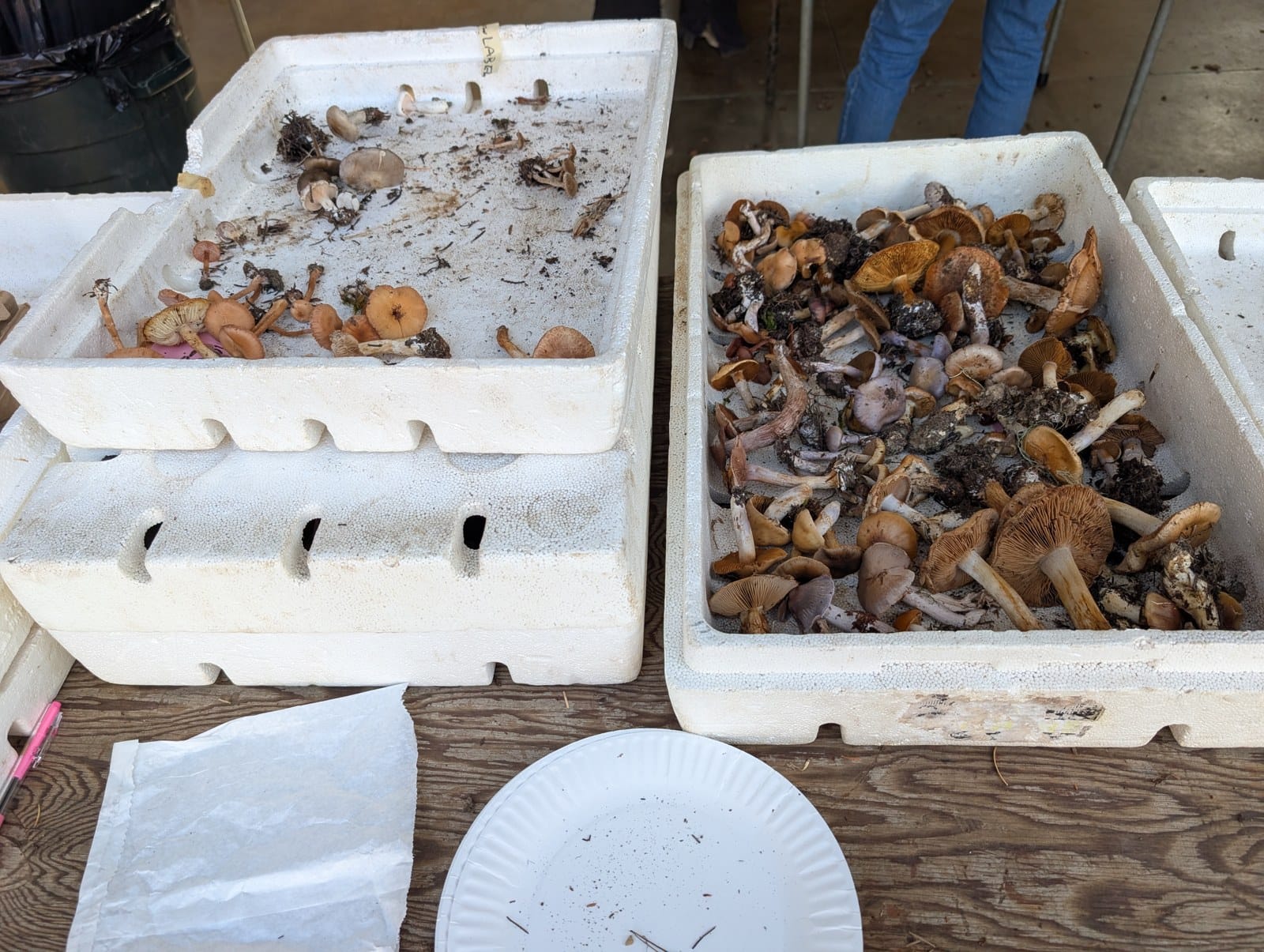
Specimen trays during preparations for the identification display.
Workshop 1: Bao buns and tonic teas
I attended Valerie Nguyen's workshop on medicinal mushroom bao buns and fall tonic teas. The presenter discussed medicinal uses of mushrooms and shared spectacular samples of reishi/ginger tea and three different delicious types of bao buns. One of the bao buns that I tried was a black sesame earthstar bao infused with candy cap mushrooms.
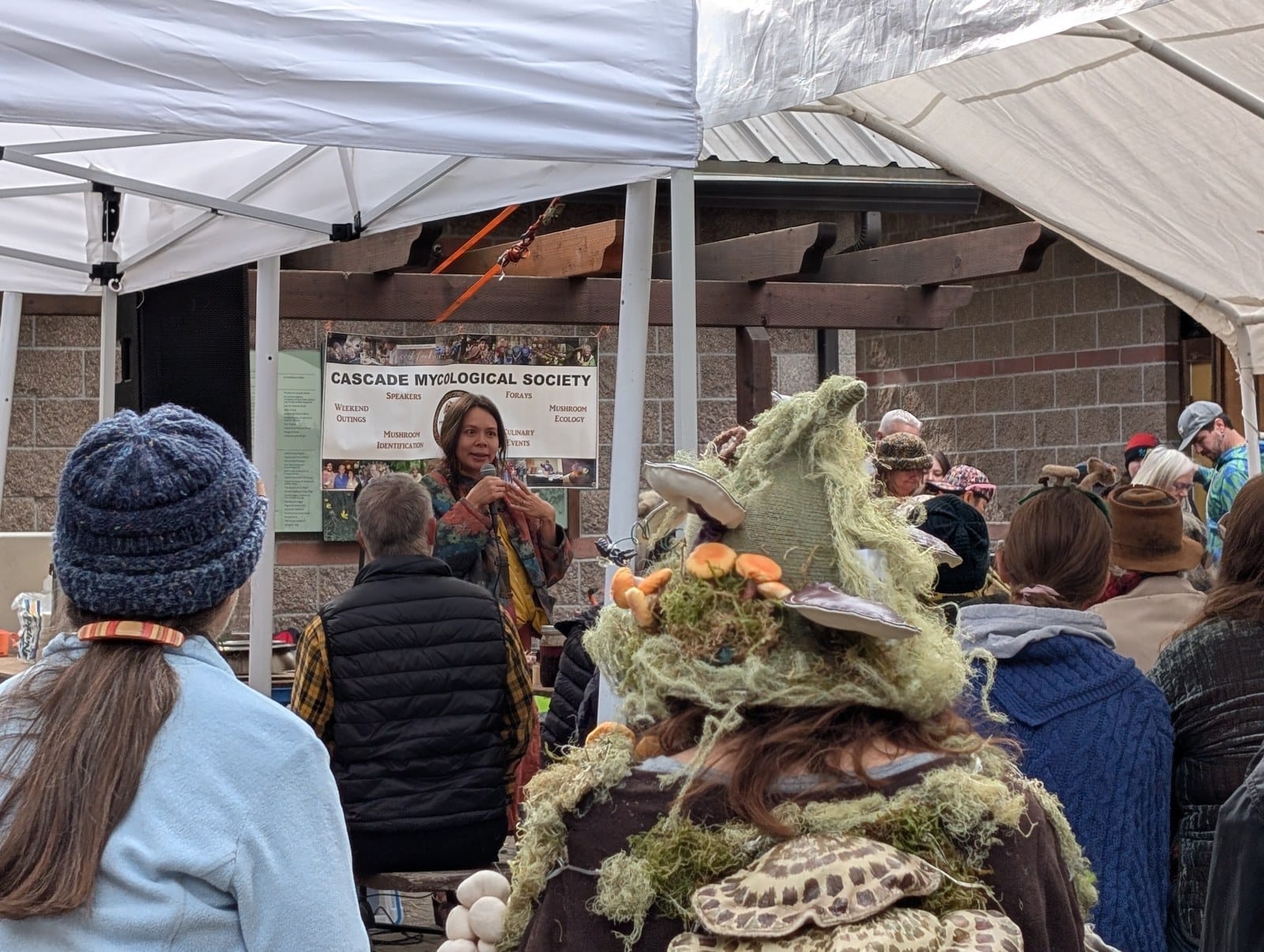
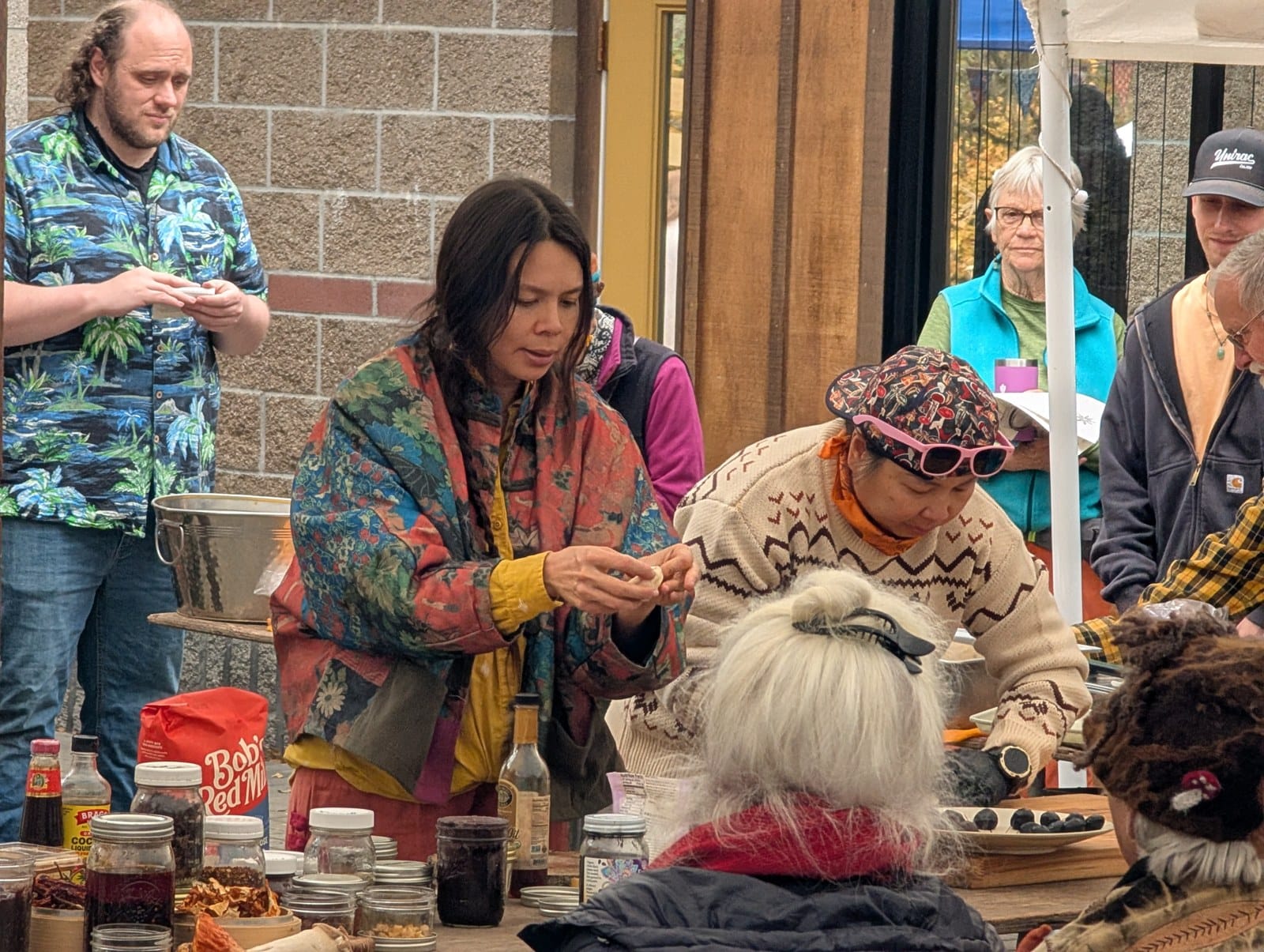
A view of the outdoor workshop and its audience. A closer view of the cooking demonstration.
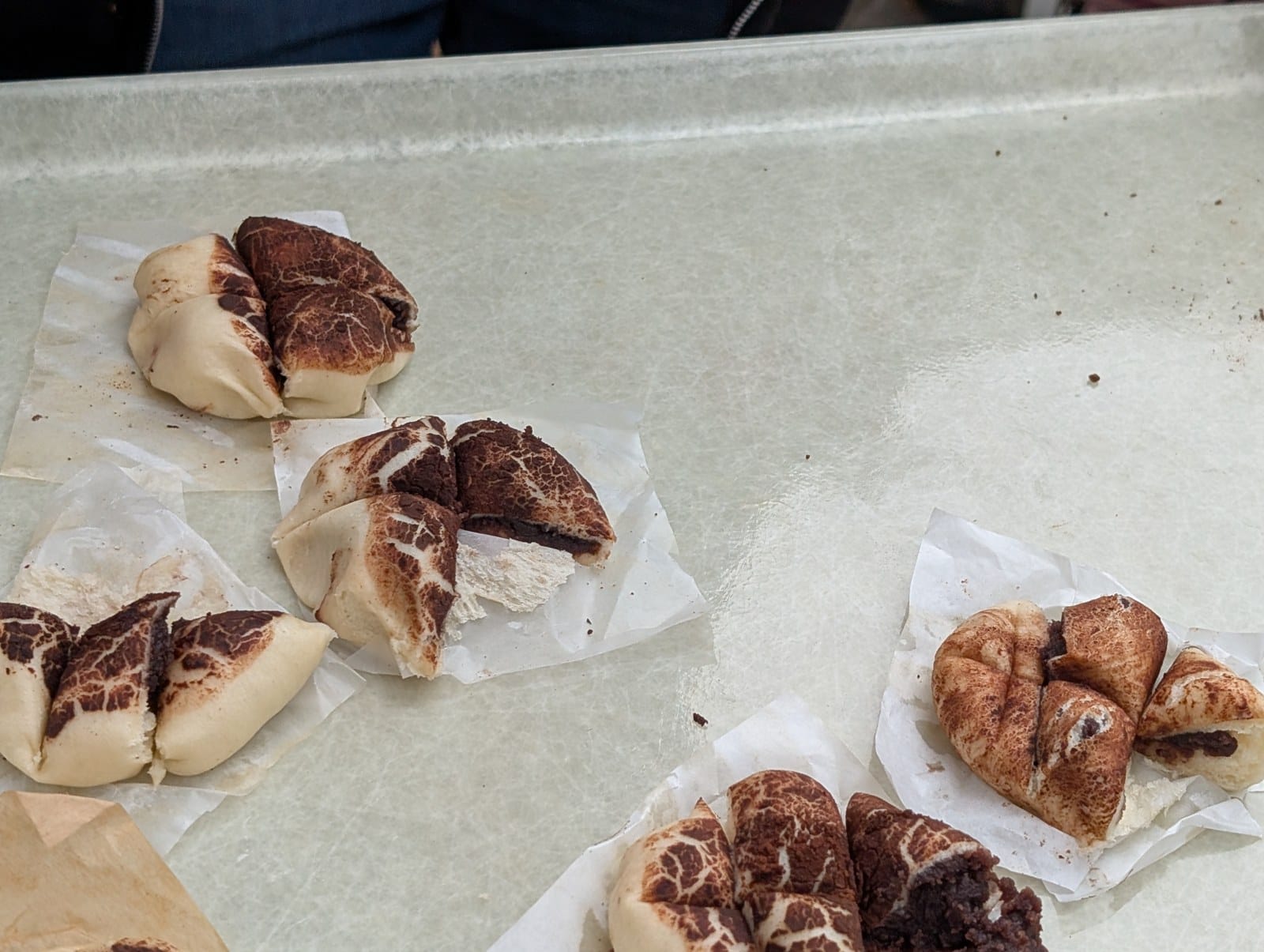
Delicious black sesame earthstar bao infused with candy cap mushrooms
After that wonderful workshop, I was really starting to get hungry, so my buddy and I went on a foray to the food section next.
Lunchtime
I had heard great reviews of the mushroom soup, so I decided to try the Hungarian mushroom soup from Rainforest Mushrooms based in Yachats, Oregon. It was the perfect food for the rainy fall weather. They even share recipes for several dishes, including the Hungarian mushroom soup, on their website.
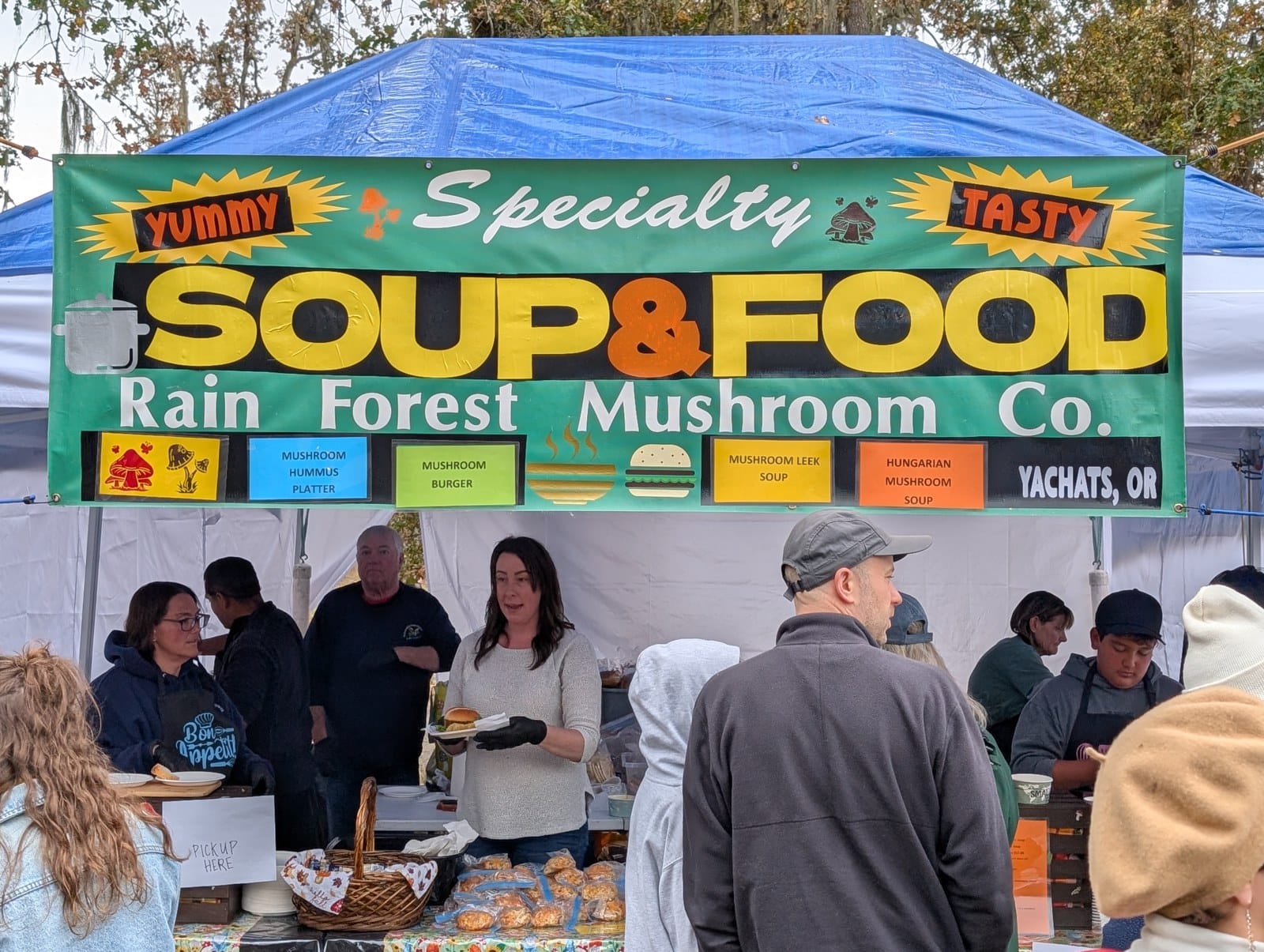
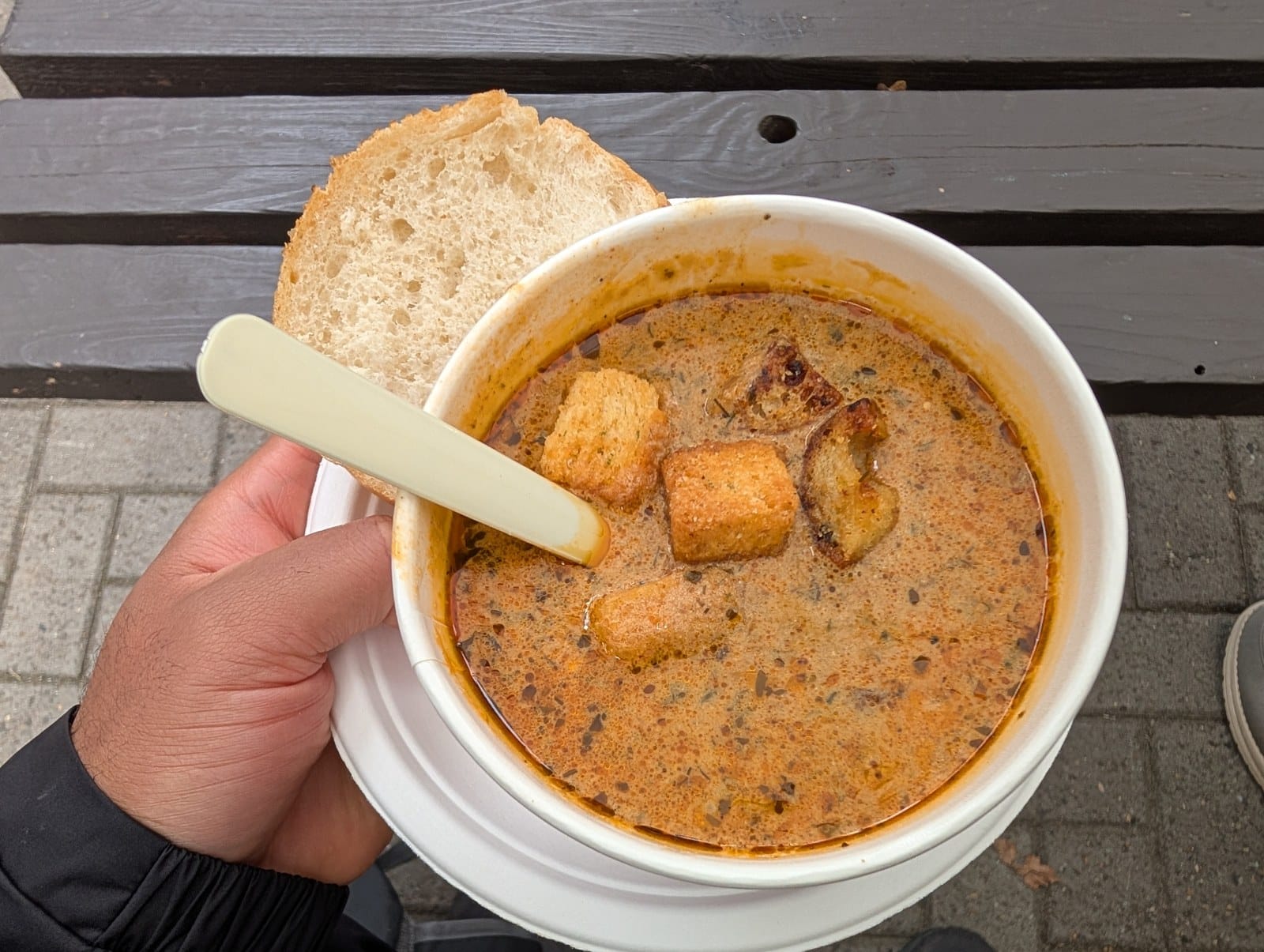
The Rain Forest Mushroom Co. soup and food booth. Hungarian mushroom soup with bread and croutons.
Workshop 2: Creamy mushroom soup
After lunch, I attended the mushroom soup demonstration by chefs Garrett and Felicia Kirsch, the husband-and-wife chefs who own and operate Seasoned in downtown Eugene. Their kitchen emphasizes cooking from scratch and sourcing locally when possible, working with Pacific Northwest farmers, ranchers, brewers, and artisans. They demonstrated how to make creamy mushroom soup, and I have included their recipe below.
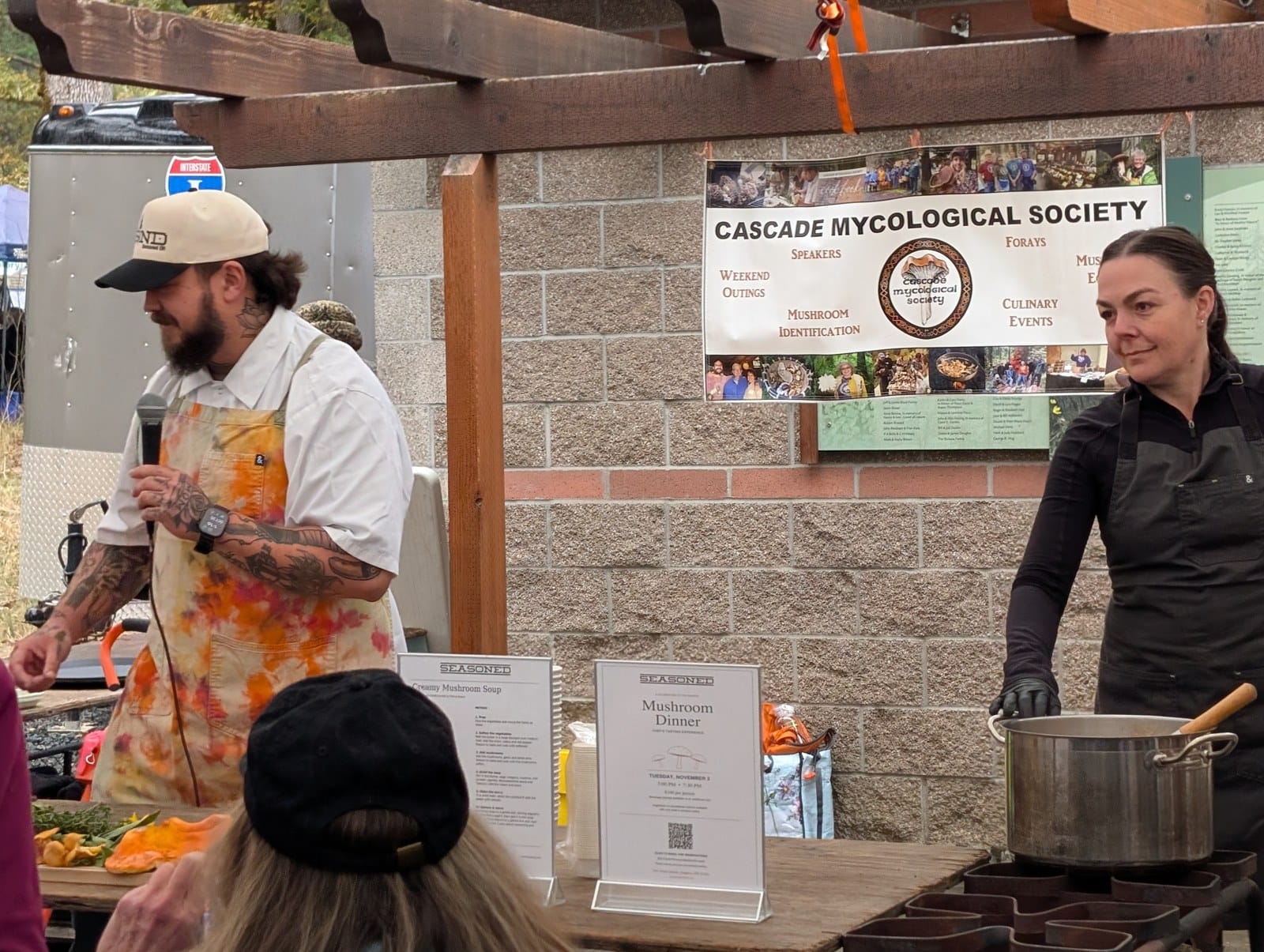
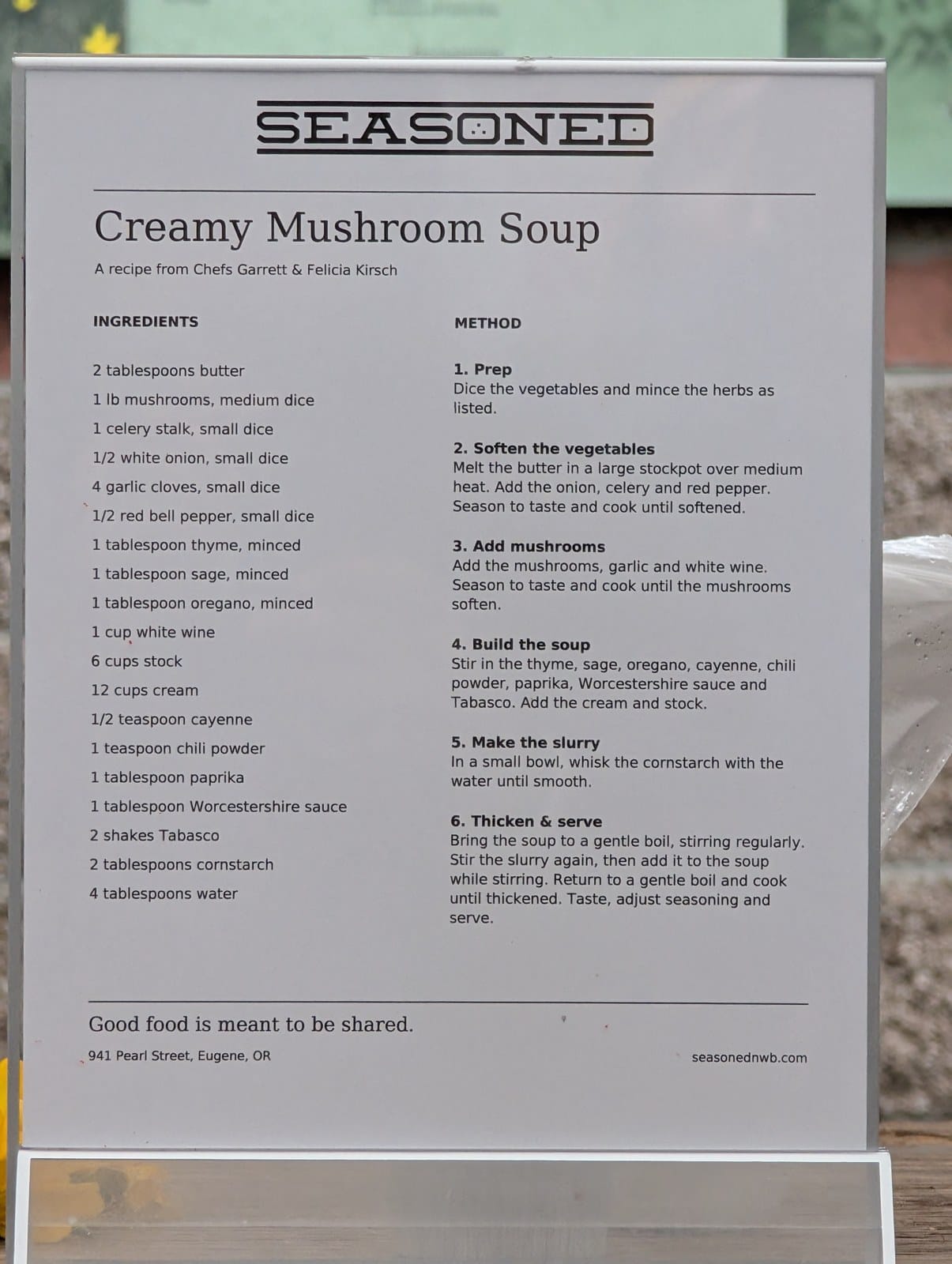
The Seasoned mushroom soup demonstration. The printed Creamy Mushroom Soup recipe at the demonstration.
The mushroom identification table
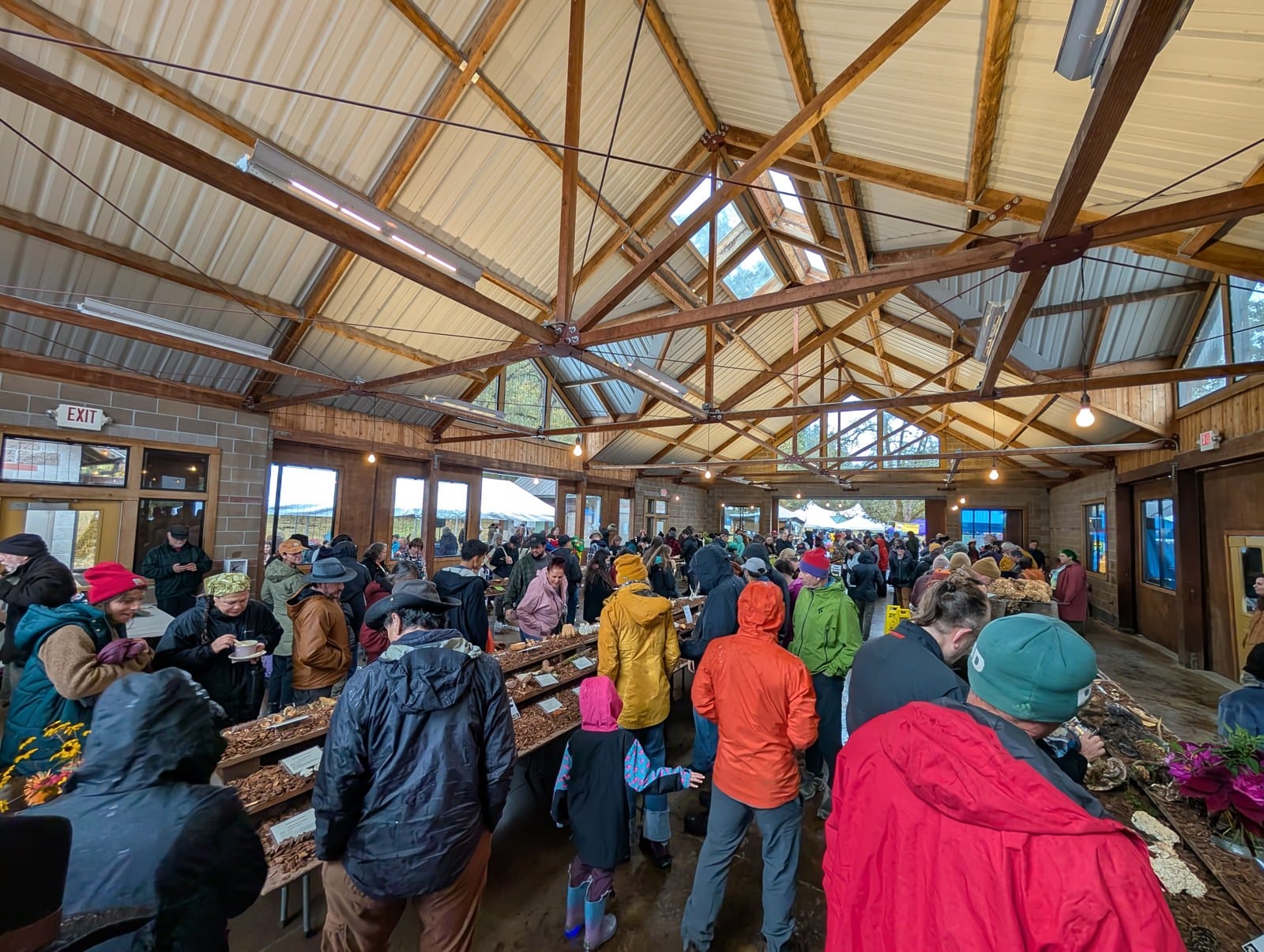
One of the many attractions at the festival is the mushroom identification table room. Volunteers collect hundreds of local fungi, which are displayed on several tables and organized into different groups. This is a great opportunity to see up close and personal what kinds of fungi grow in the region.
I brought a UV flashlight, and my friend pointed it at different specimens while we were mesmerized by the few mushrooms that glowed brightly with different colors. Under the light, mushrooms labeled Cortinarius clandestinus, Flammula alnicola, Gymnopilus luteofolius, Hebeloma velutipes, Hygrophorus pudorinus, and Hypholoma fasciculare showed blue-green or yellow-green patches compared to how they looked under ordinary light.
Fluorescence happens when substances absorb UV light and re-emit some energy as visible light. This requires external excitation, which is different from bioluminescence that uses chemical reactions. Fluorescence is also a useful tool for identifying certain mushrooms.
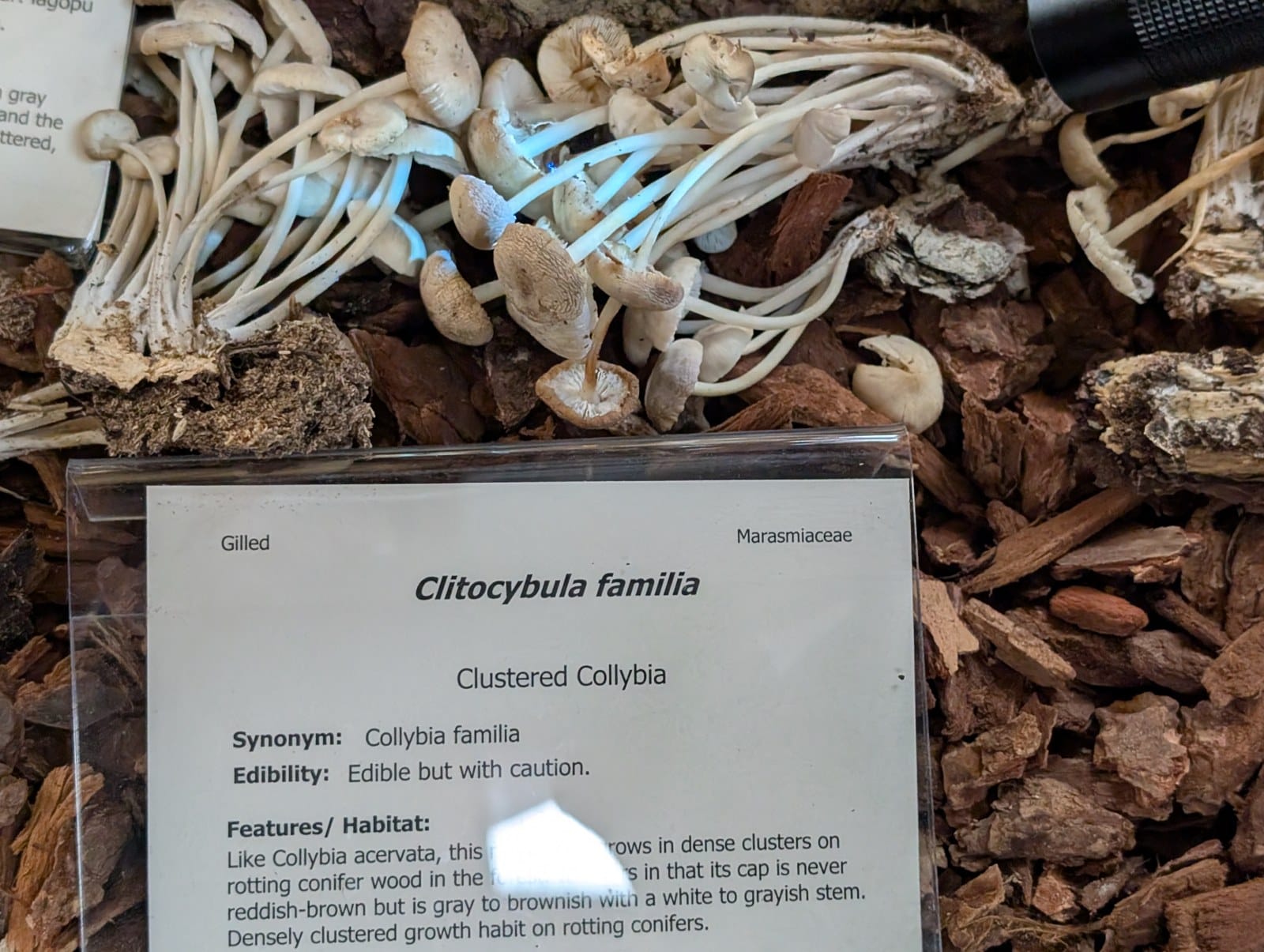
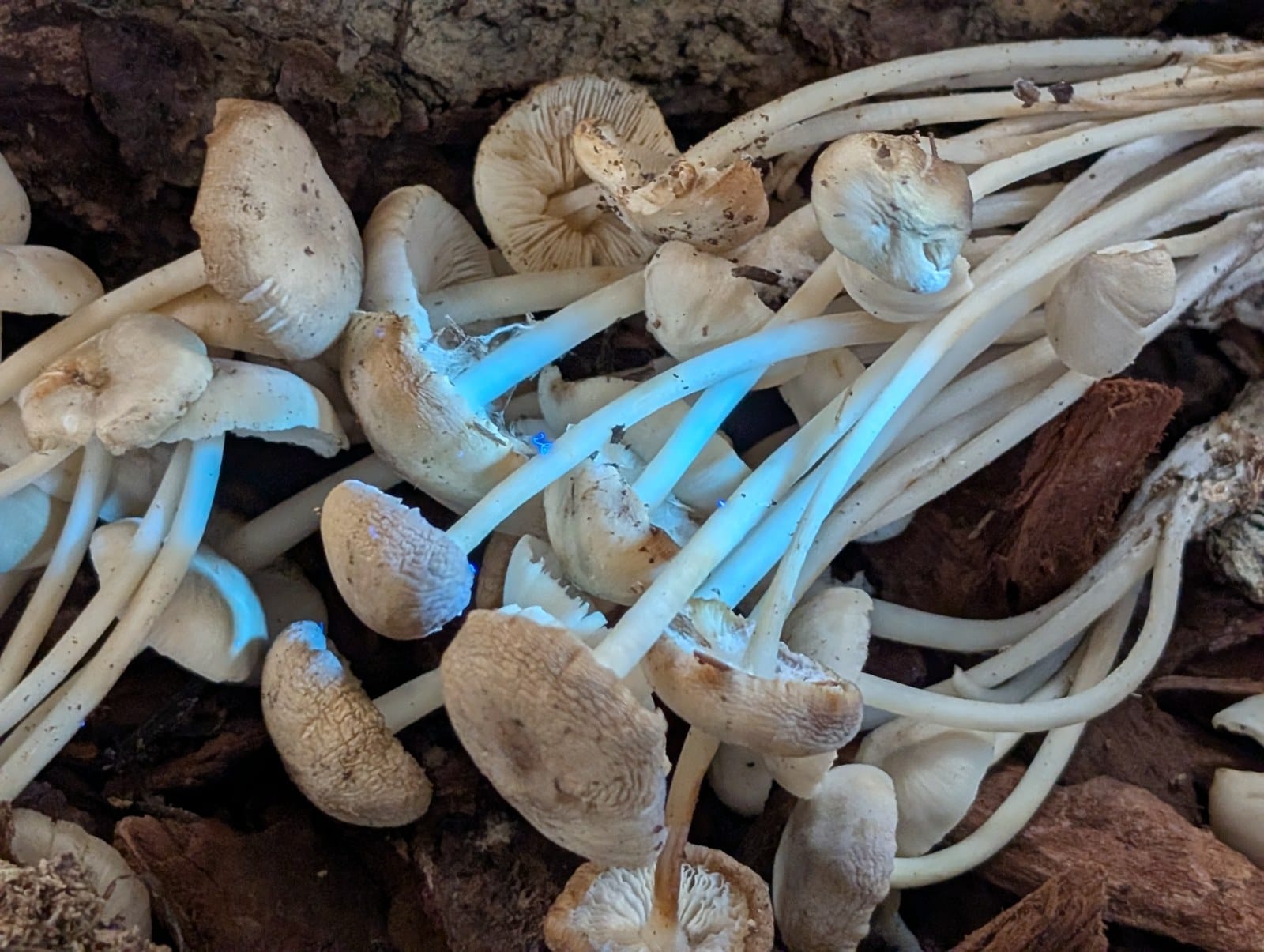
Clustered mushrooms labeled Clitocybula familia, with the UV light directed toward the stems. A closer view of the same cluster under the UV flashlight.
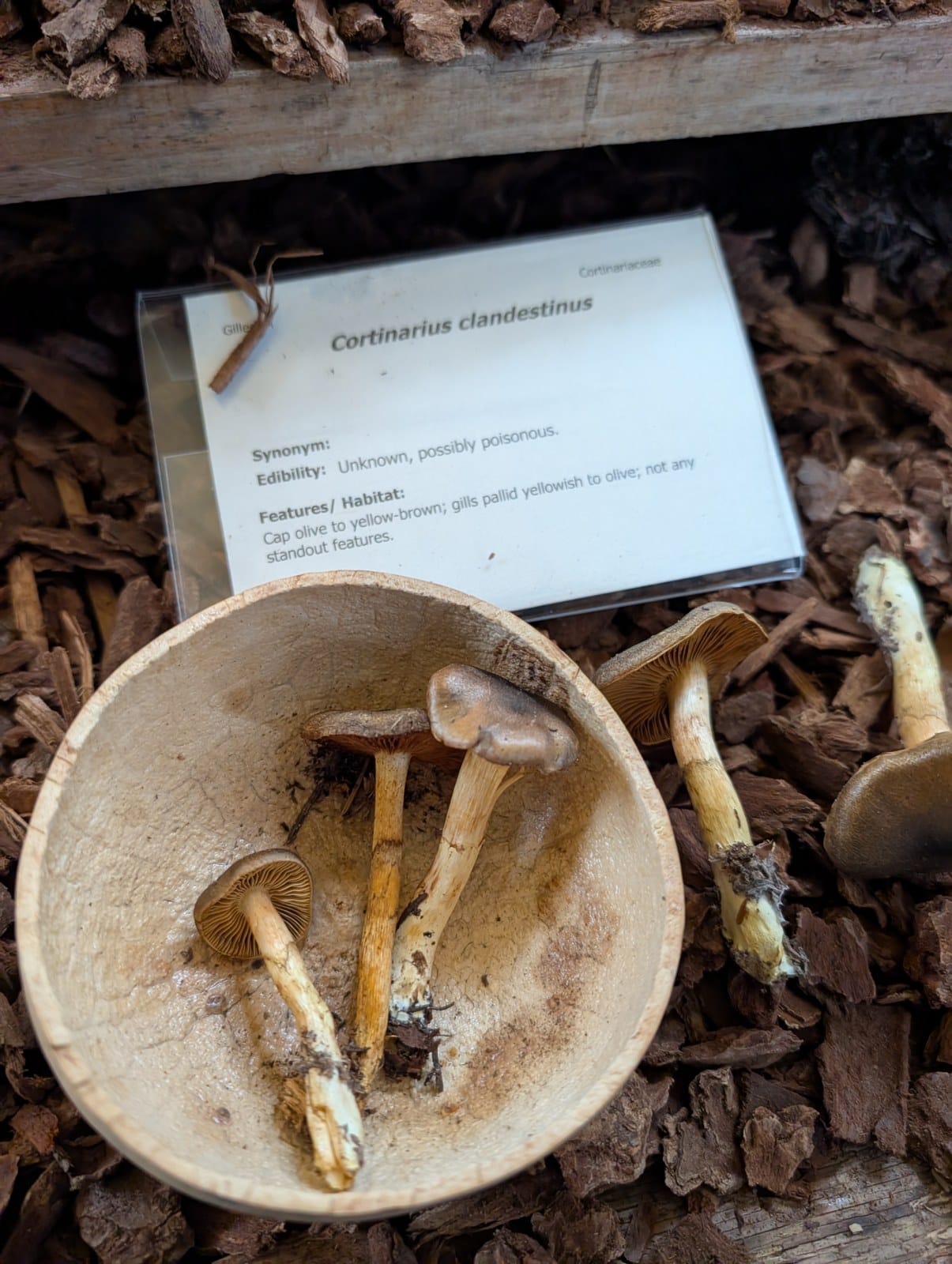
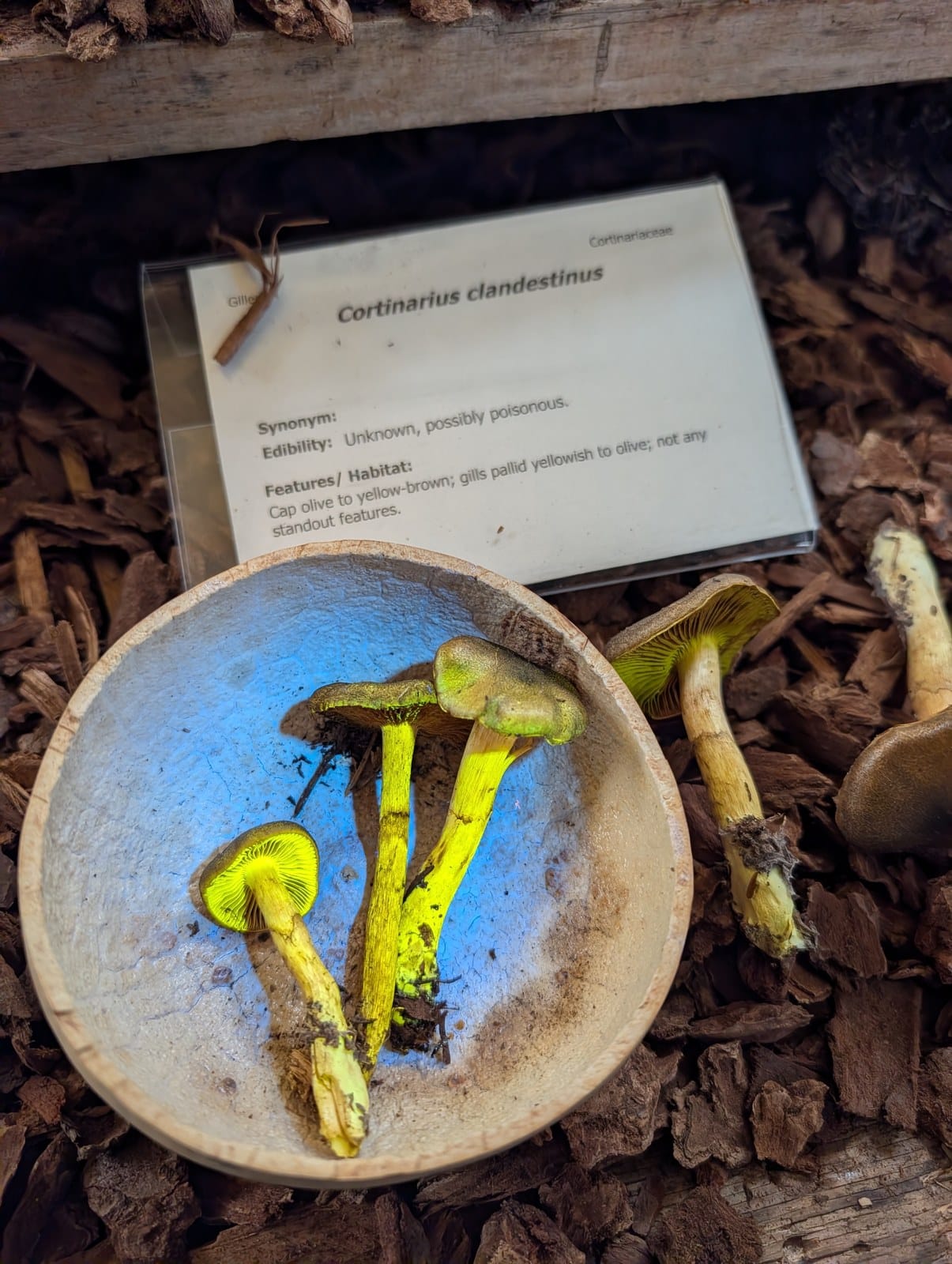
Specimens labeled Cortinarius clandestinus in ordinary light. The same Cortinarius clandestinus display under the UV flashlight.
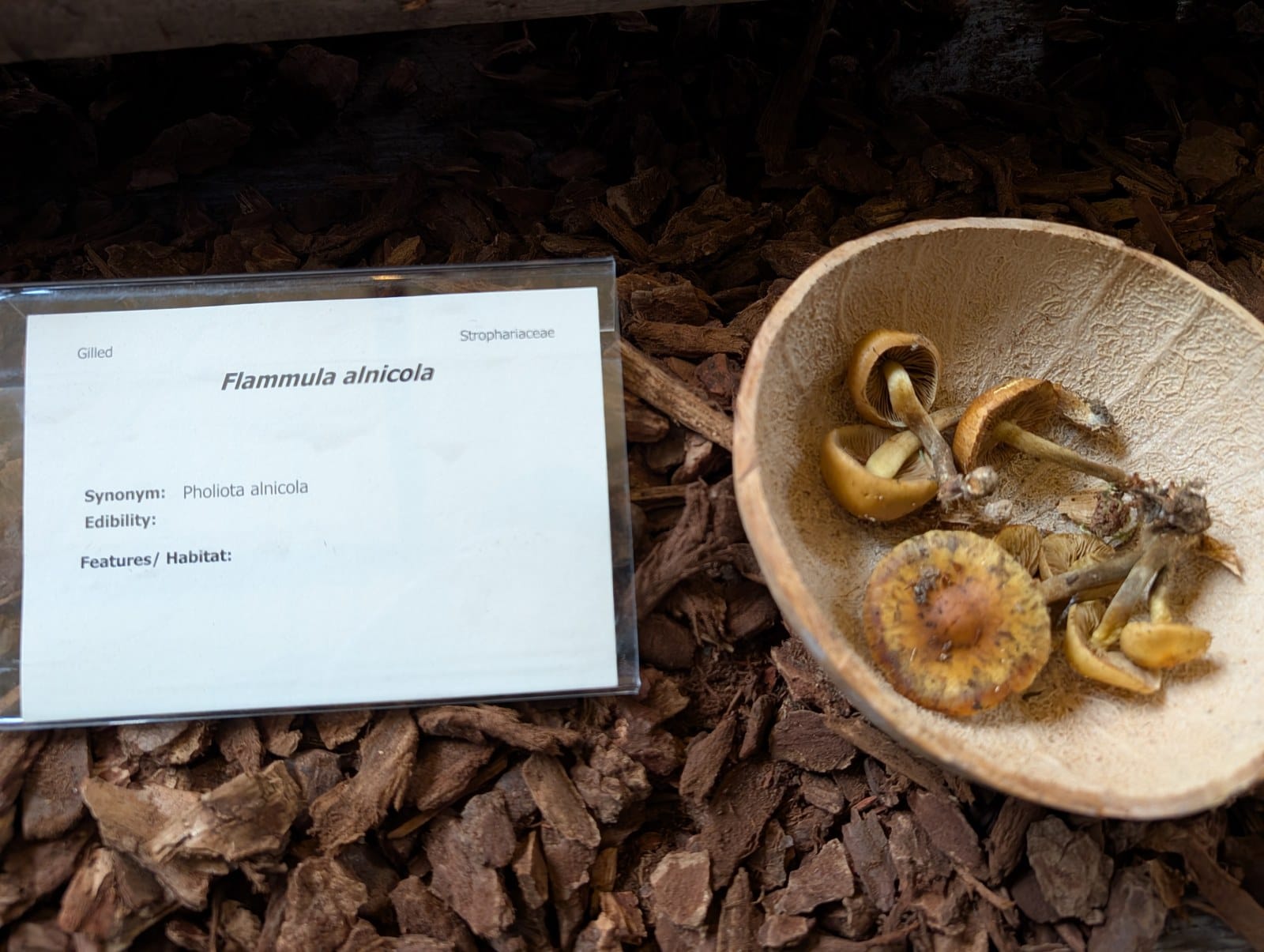
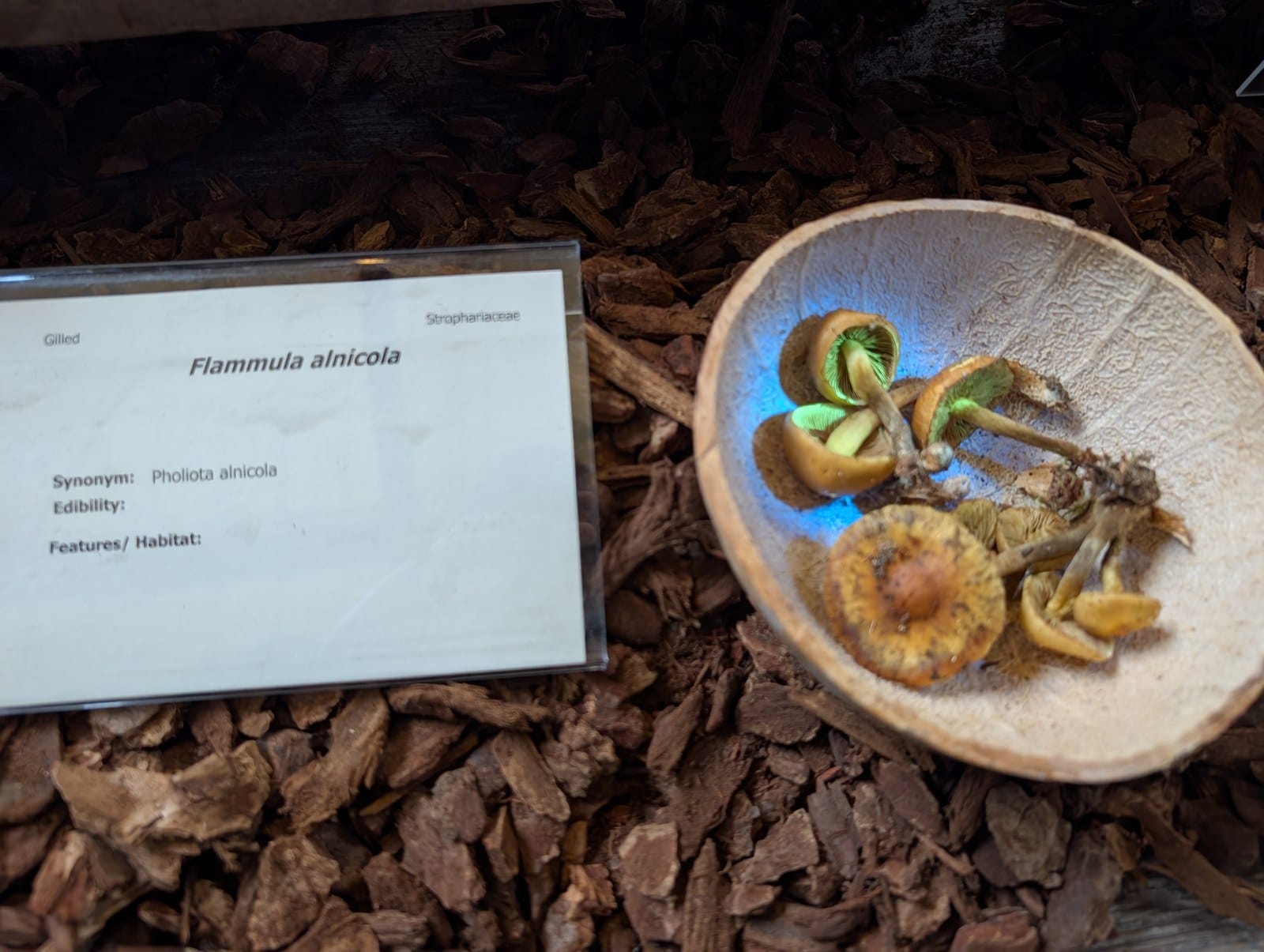
The same Flammula alnicola display in ordinary light and under the UV flashlight.
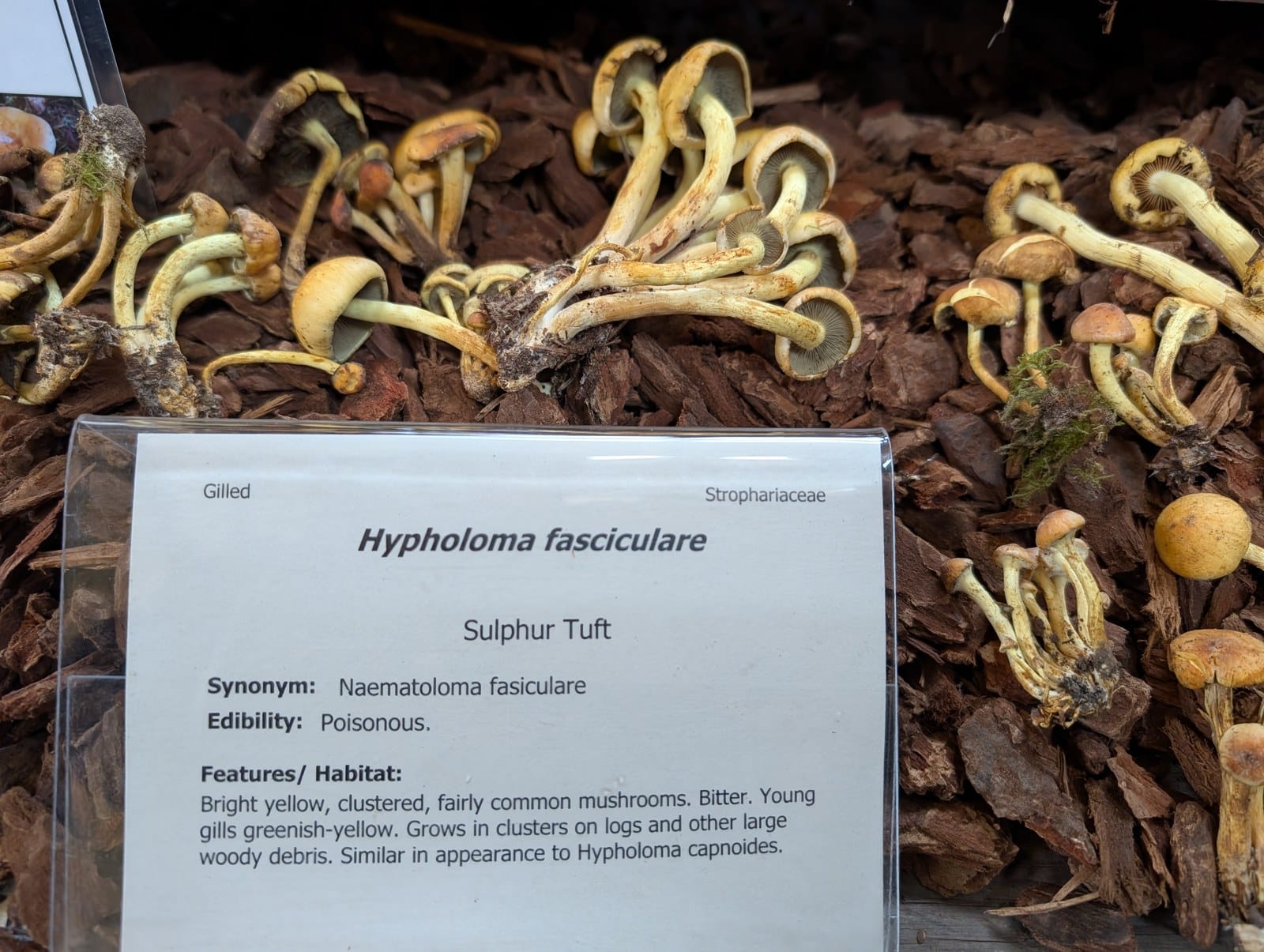
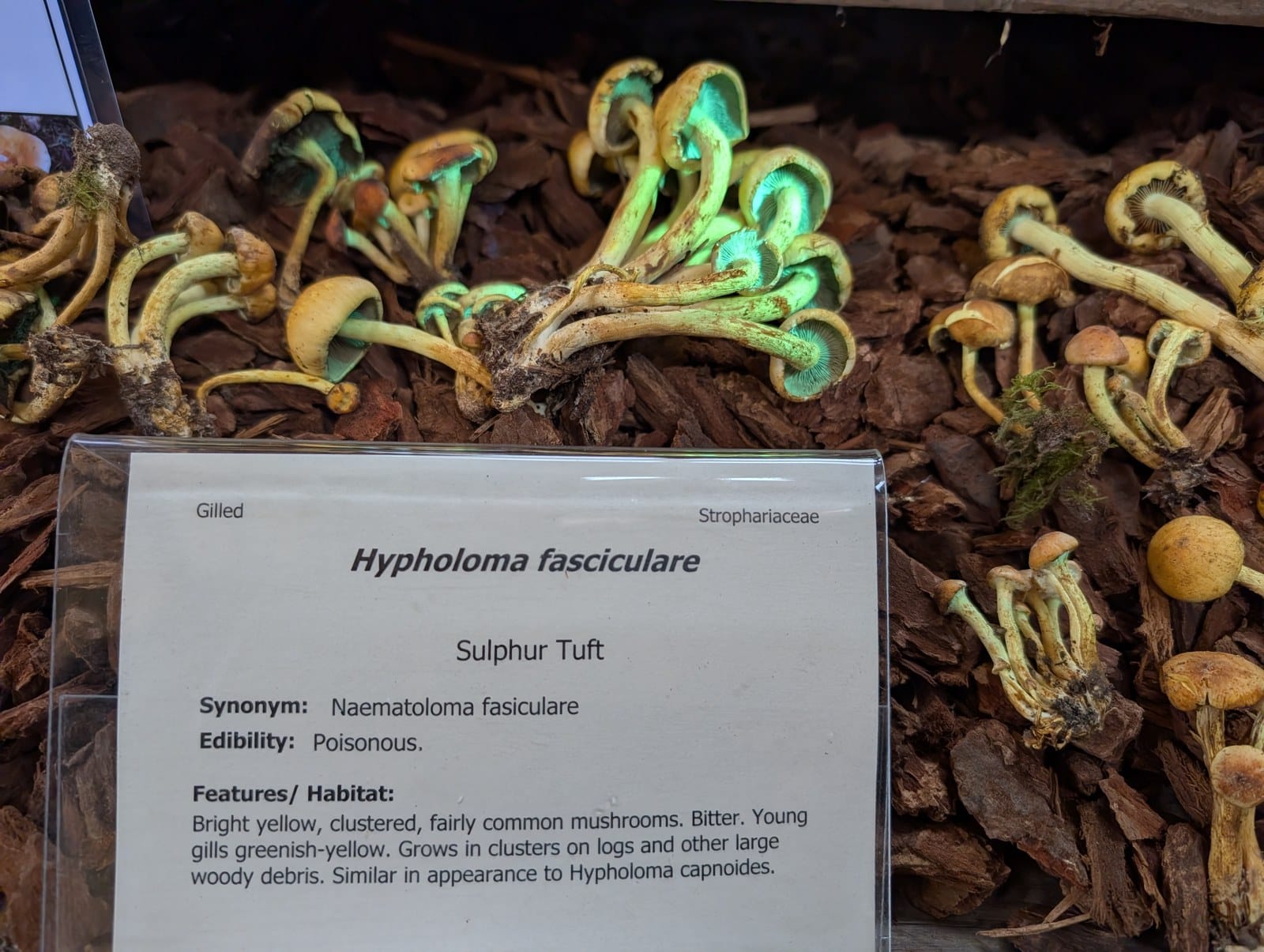
Sulphur tuft display in ordinary light and under the UV flashlight.
Some of the fungi had interesting/pleasant aromas. One in particular was the Licorice Stick, fragrant hydnellum.
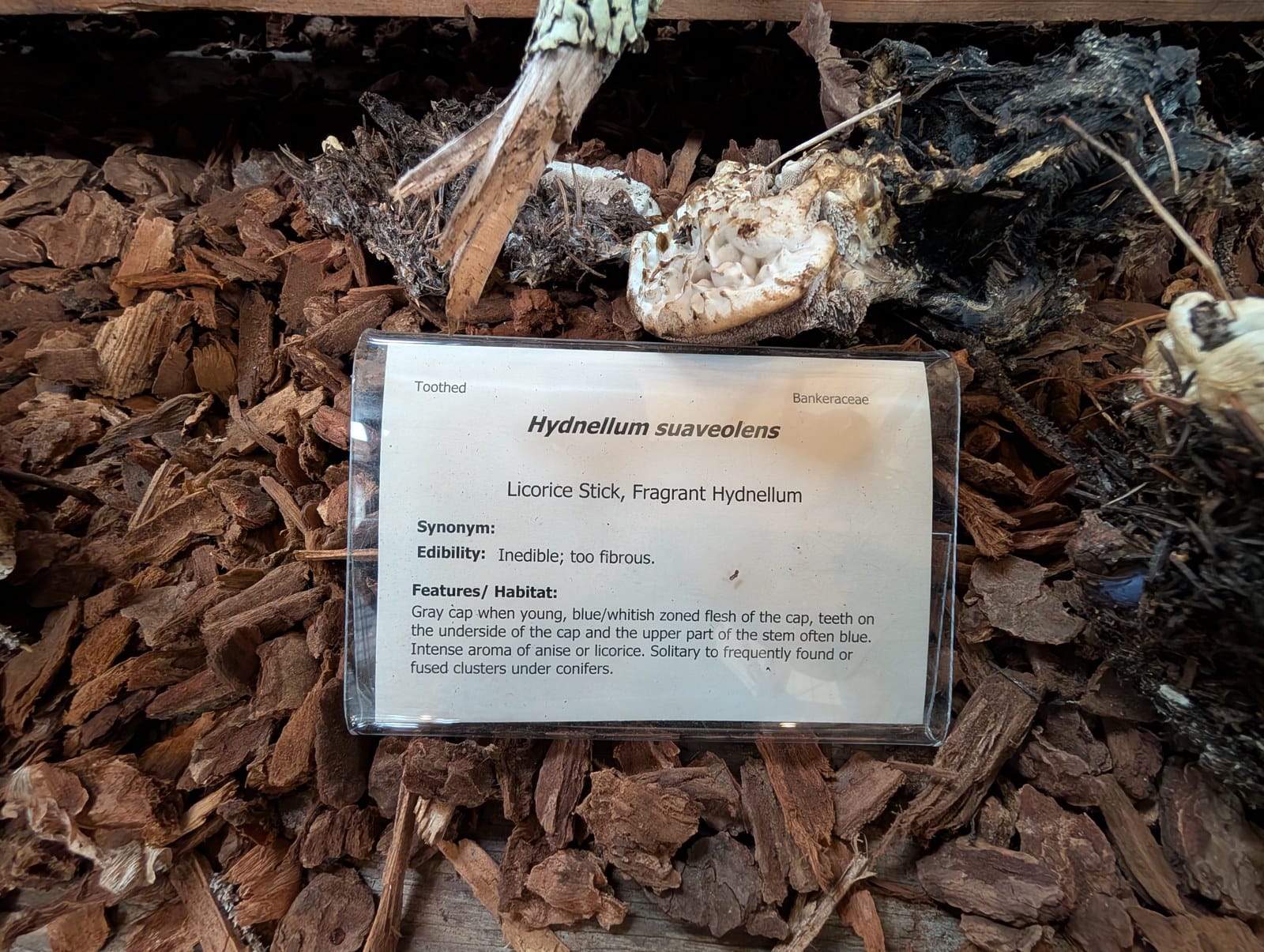
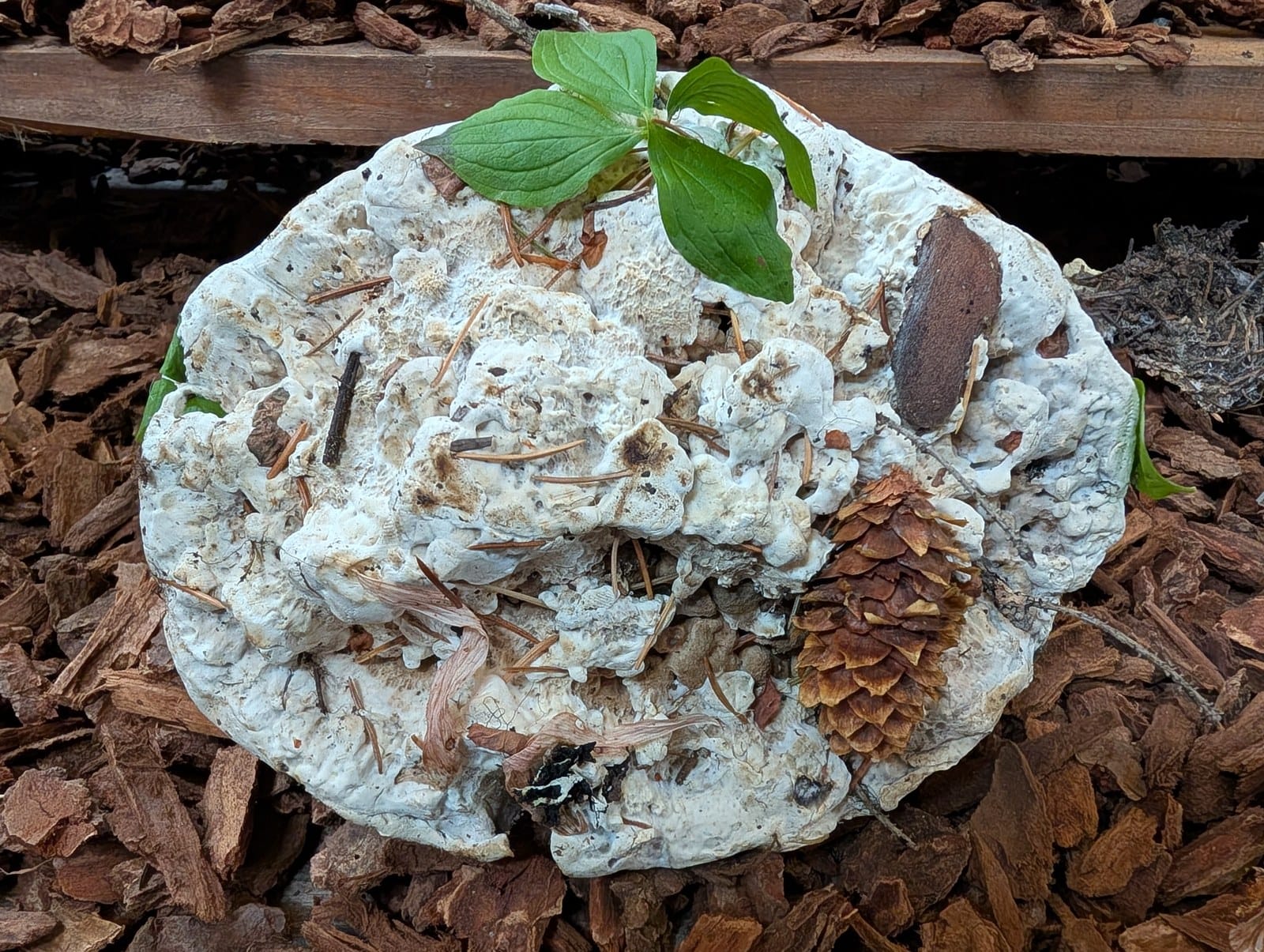
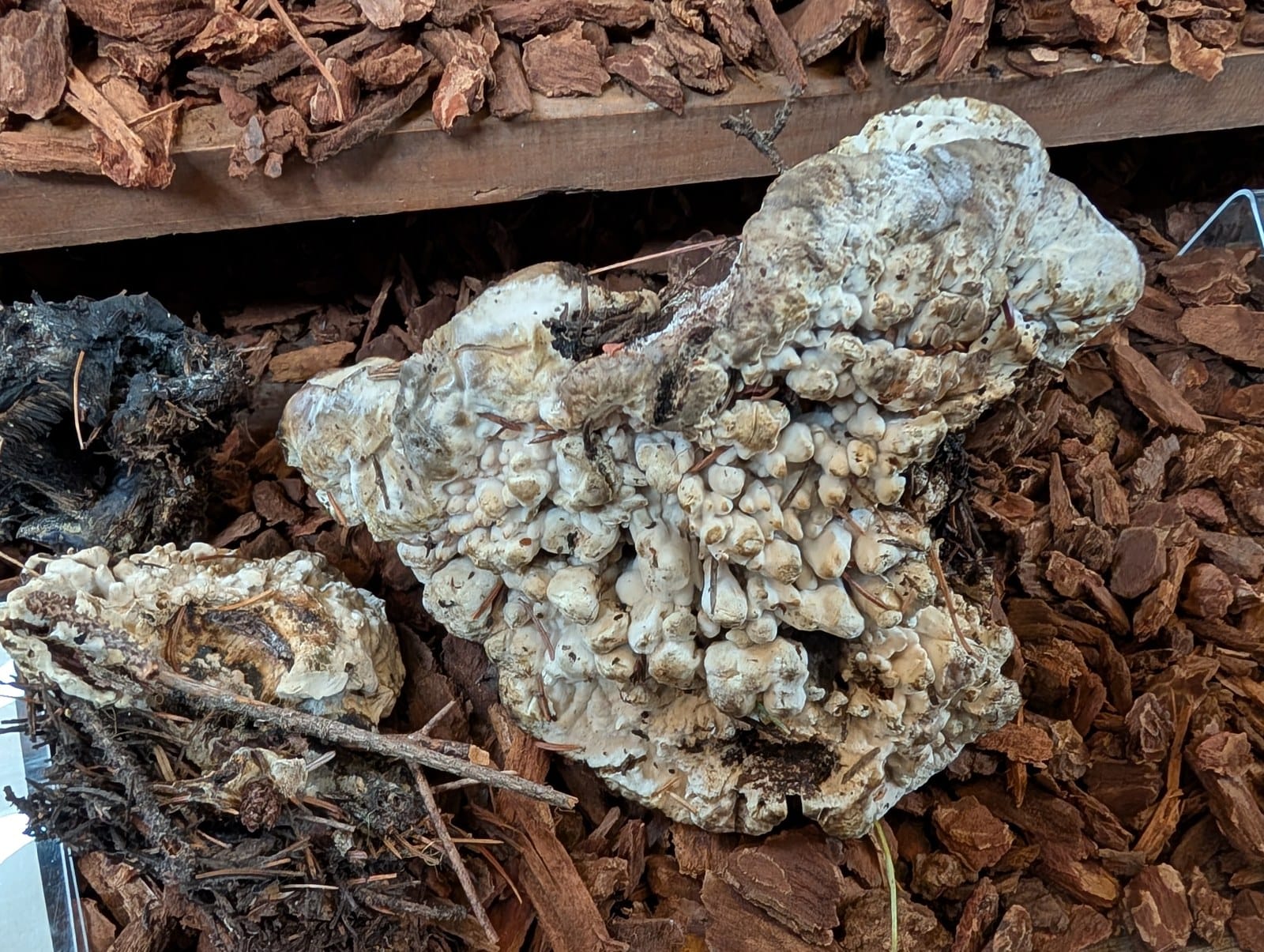
A pale Hydnellum suaveolens specimen on the identification table. A closer look at other specimens.
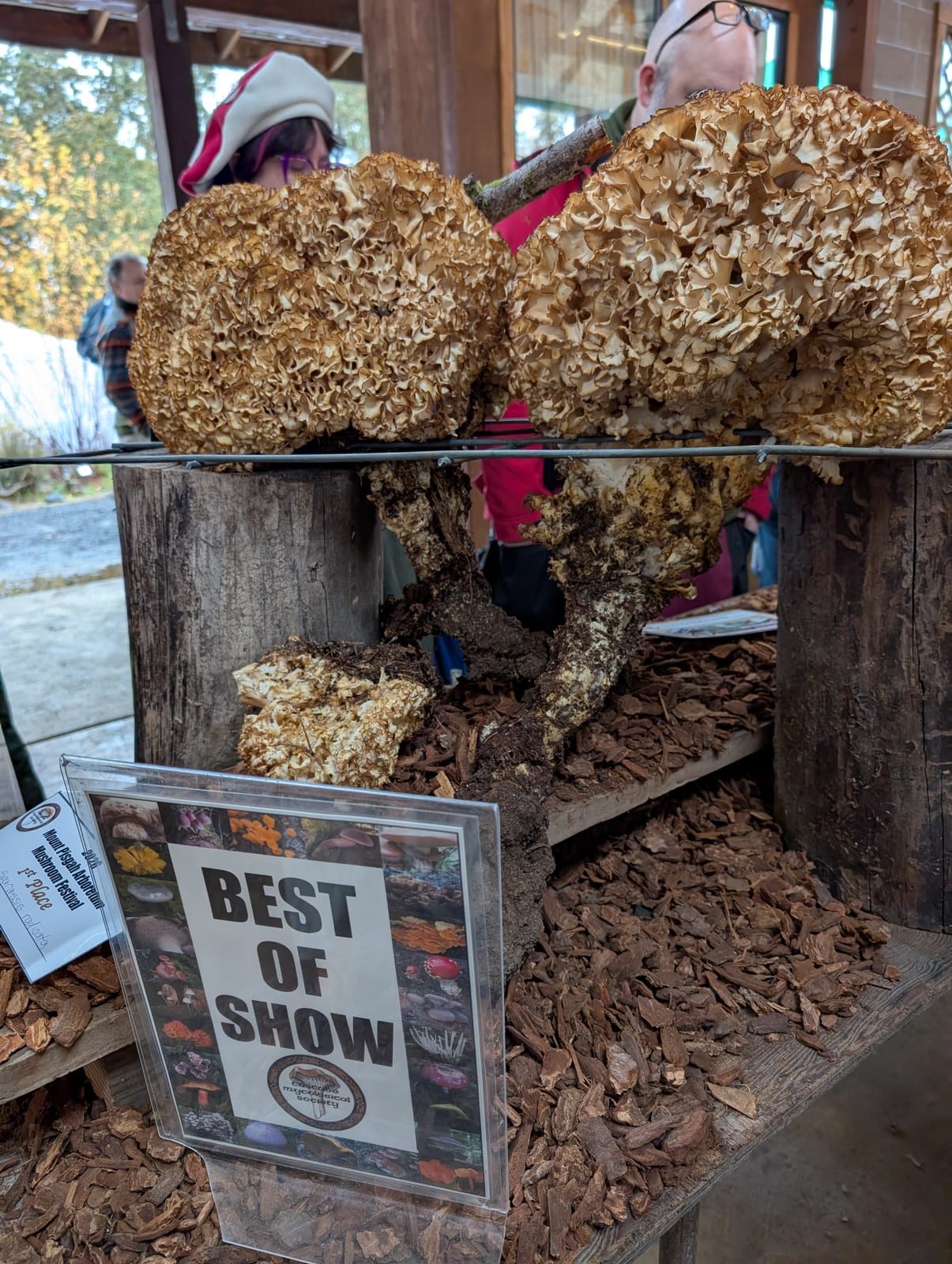
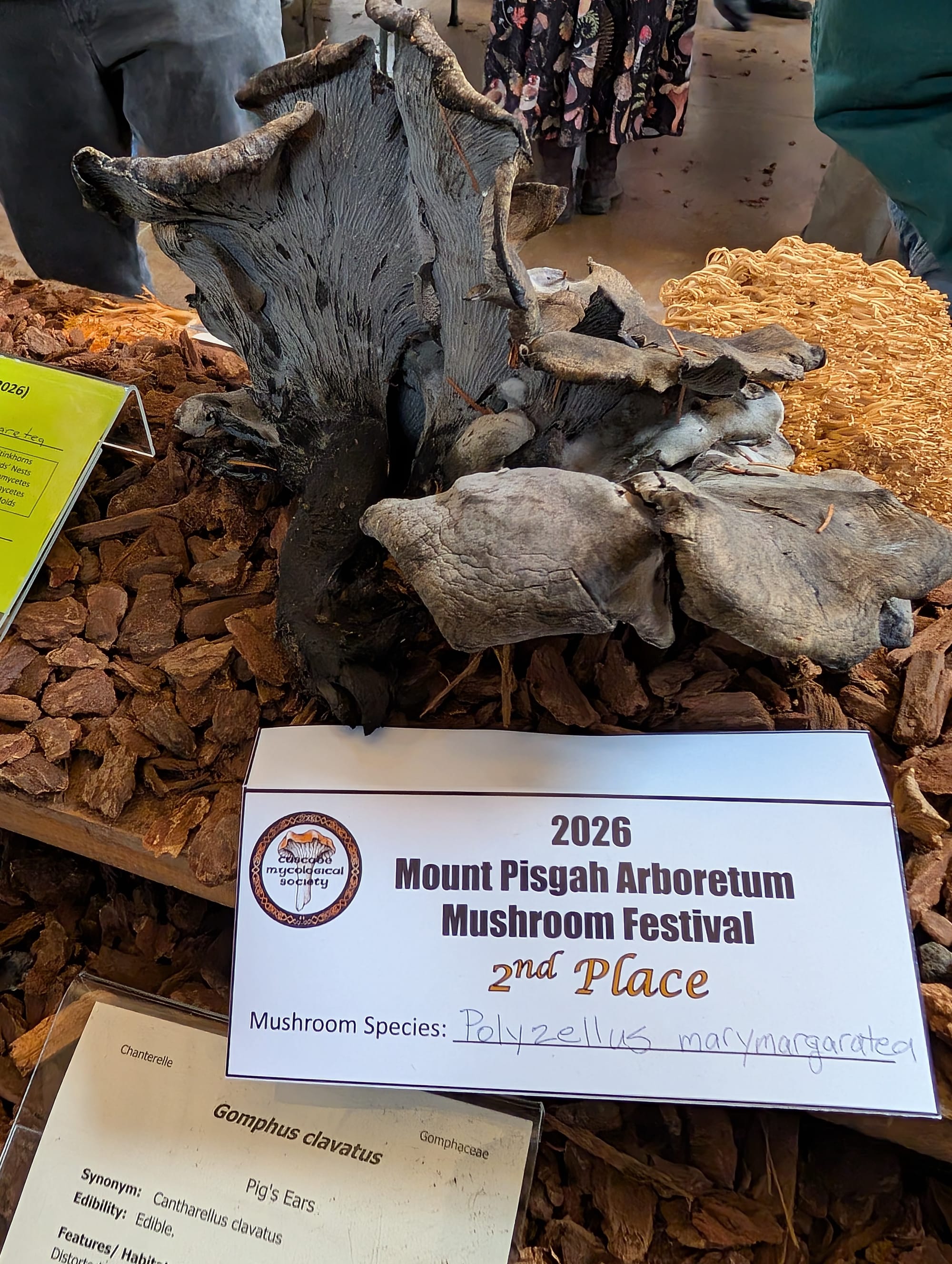
Best of Show and second-place specimens at the festival.
Mushrooms for color
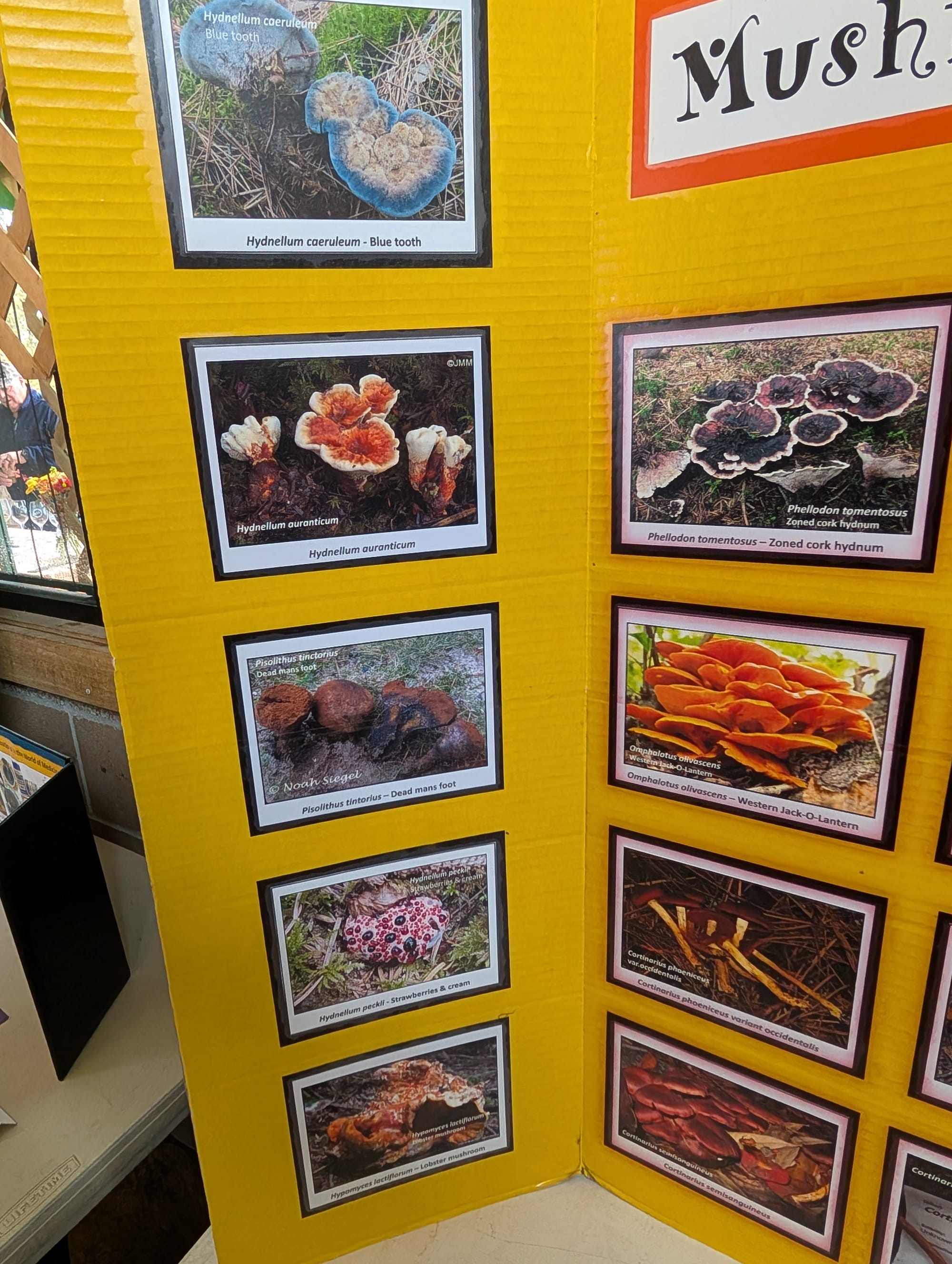
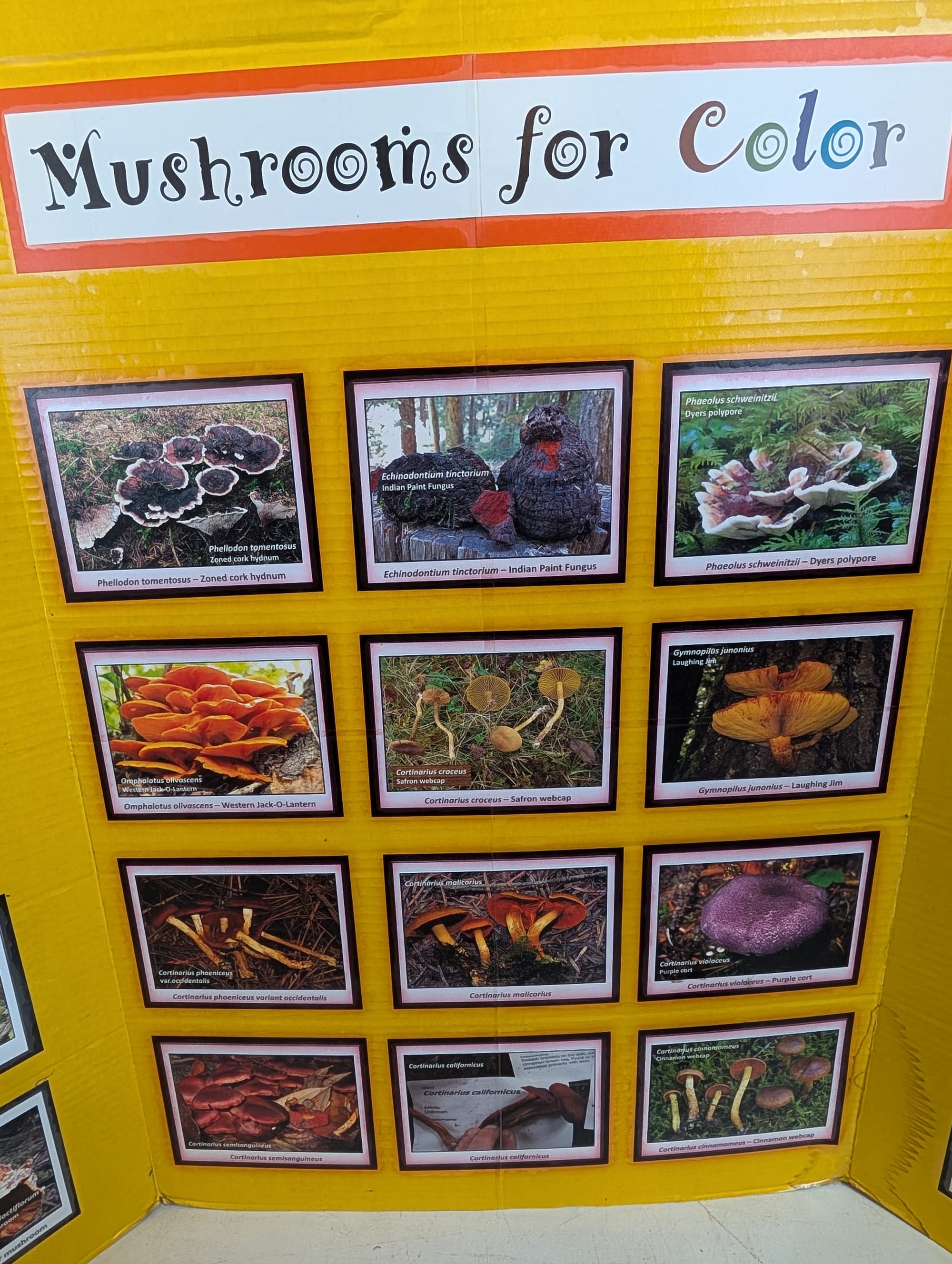
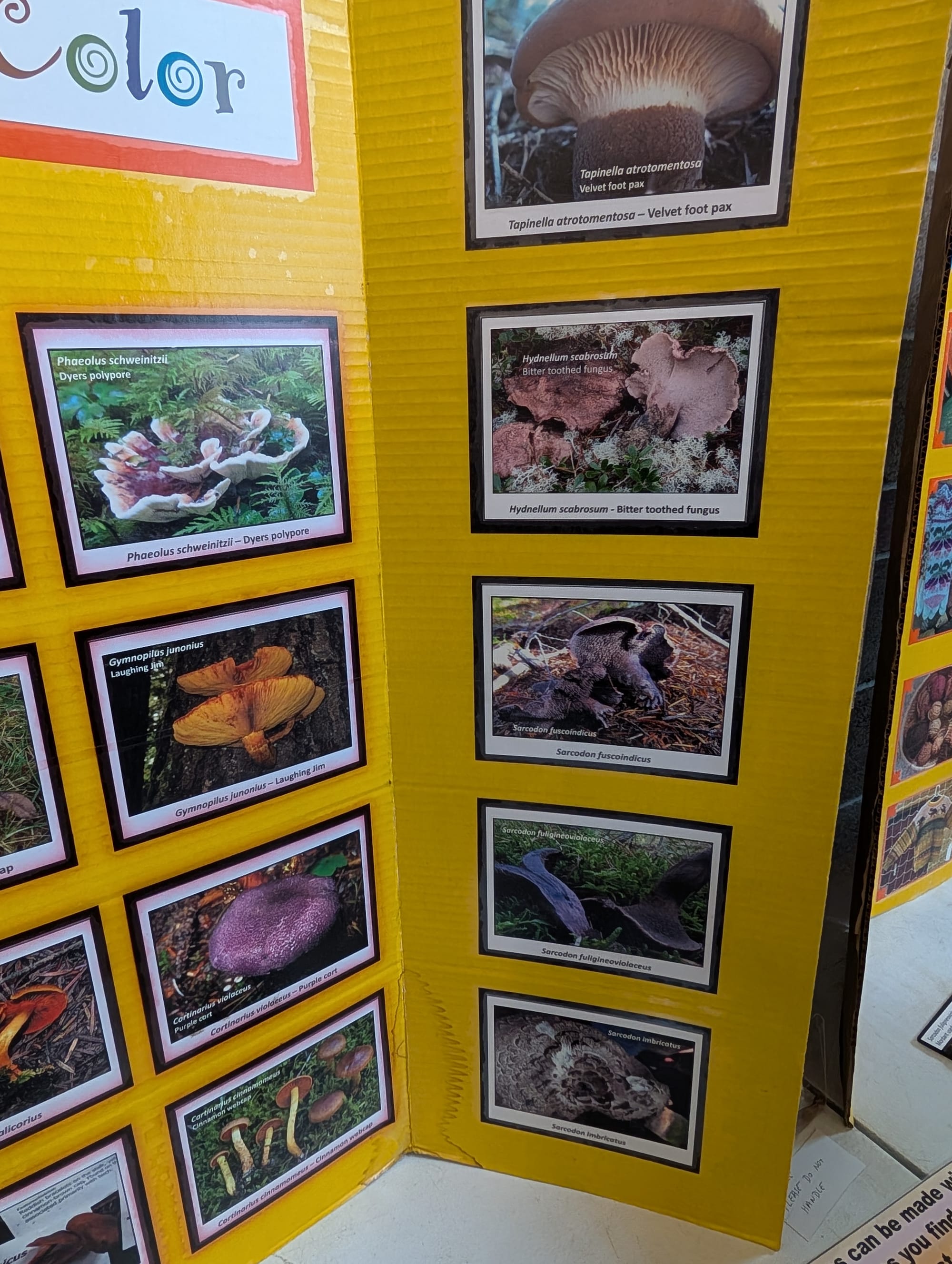
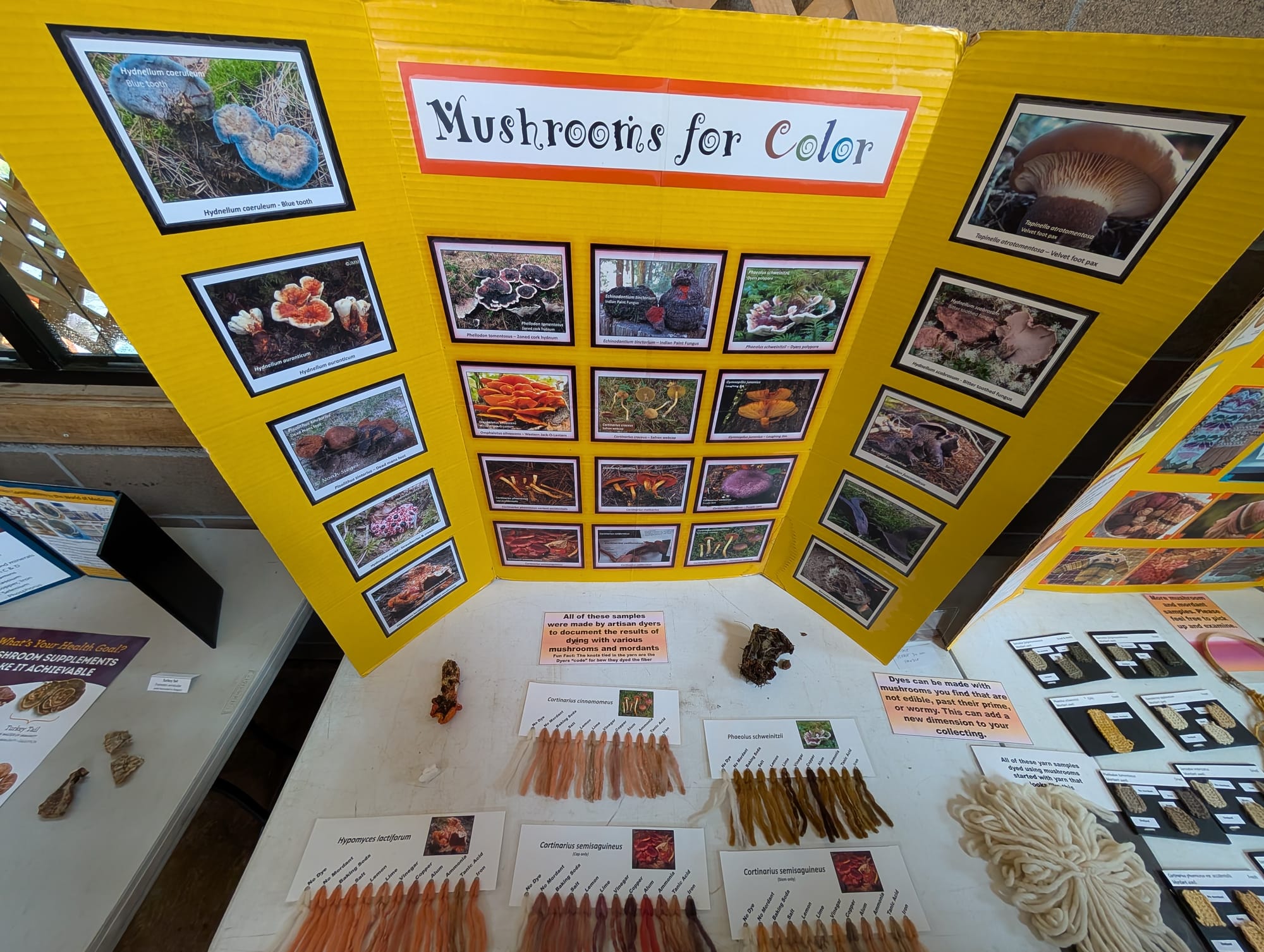
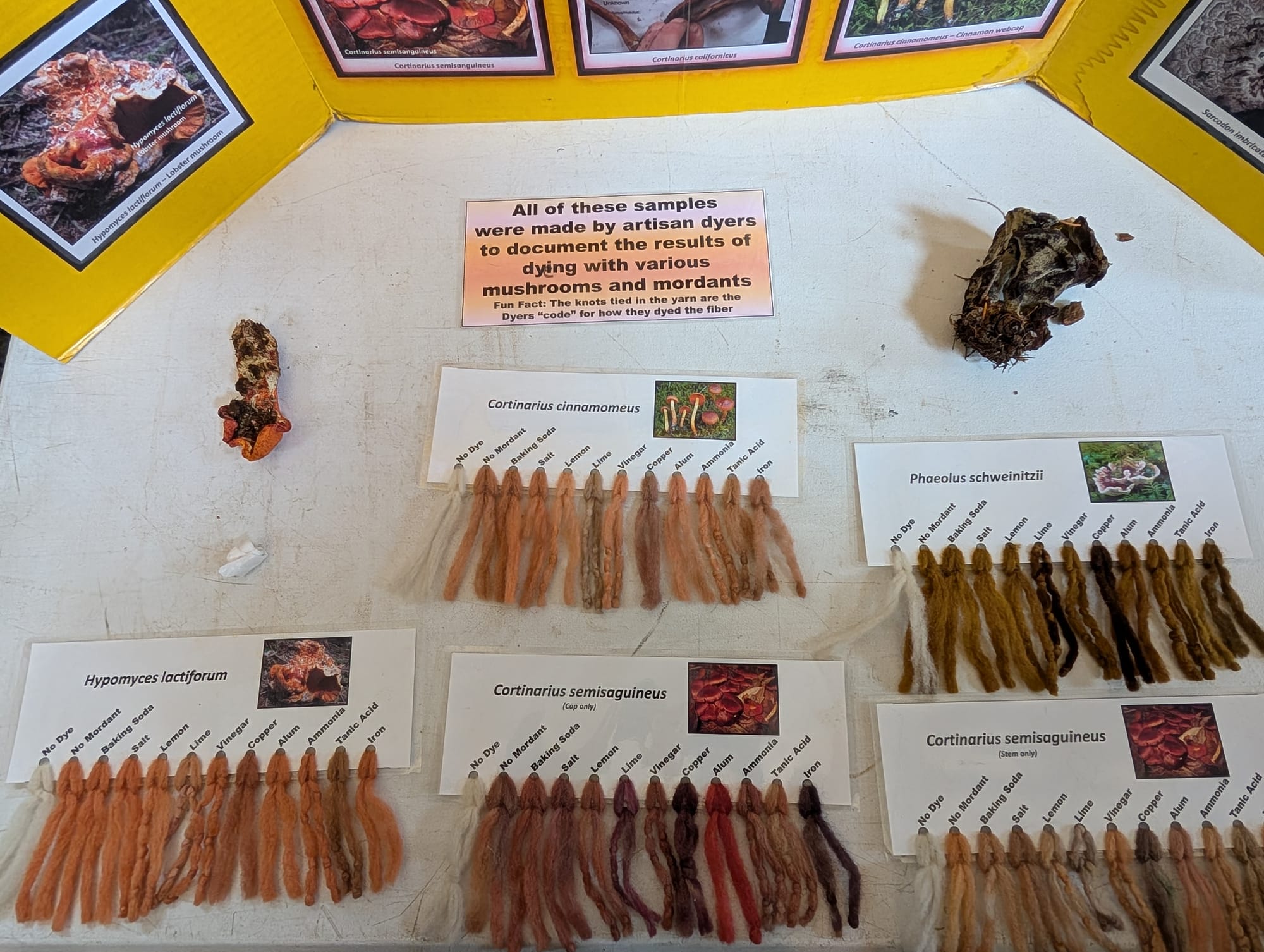
The Mushrooms for Color exhibit featured a reference board with yarn swatches. Labels identified Cortinarius cinnamomeus, Cortinarius semisanguineus, Phaeolus schweinitzii, and Hypomyces lactifluorum.
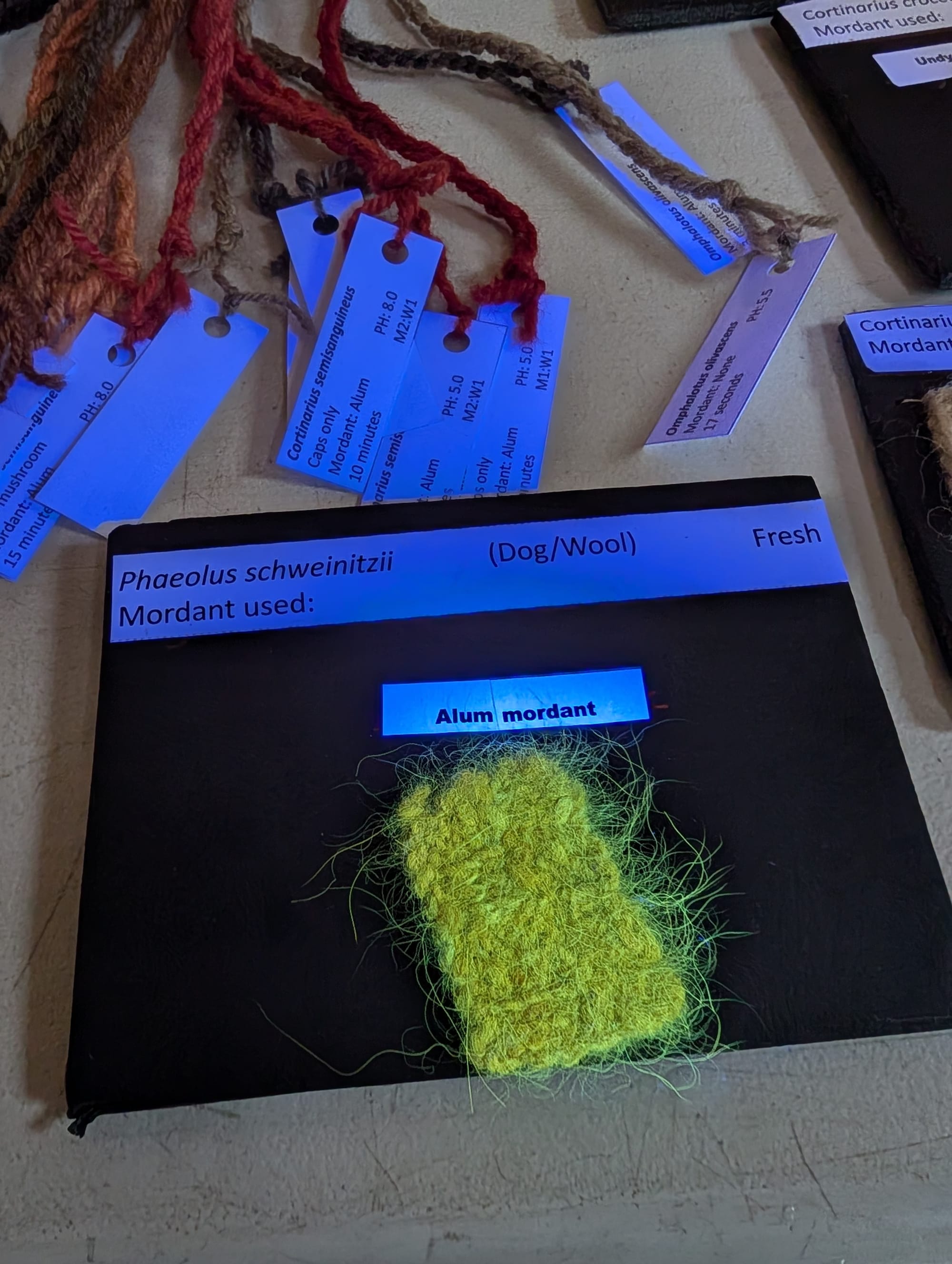
Sample rows showed no dye, no mordant, and different treatments. Mordants help fix dyes to fiber and can alter the resulting color. The swatches ranged from peach, rust, and yellow-brown to deeper red and purple. Caps and stems were provided as separate comparisons. Some of the fabric that was dyed with fluorescent fungi (such as the dyer's polypore) also glowed under UV light.
Truffles and the smell test
I viewed the truffle-like fungi display next. The Leucogaster rubescens was one of my favorites. It has a very strong aroma that smelled like a sweet and exotic spice.
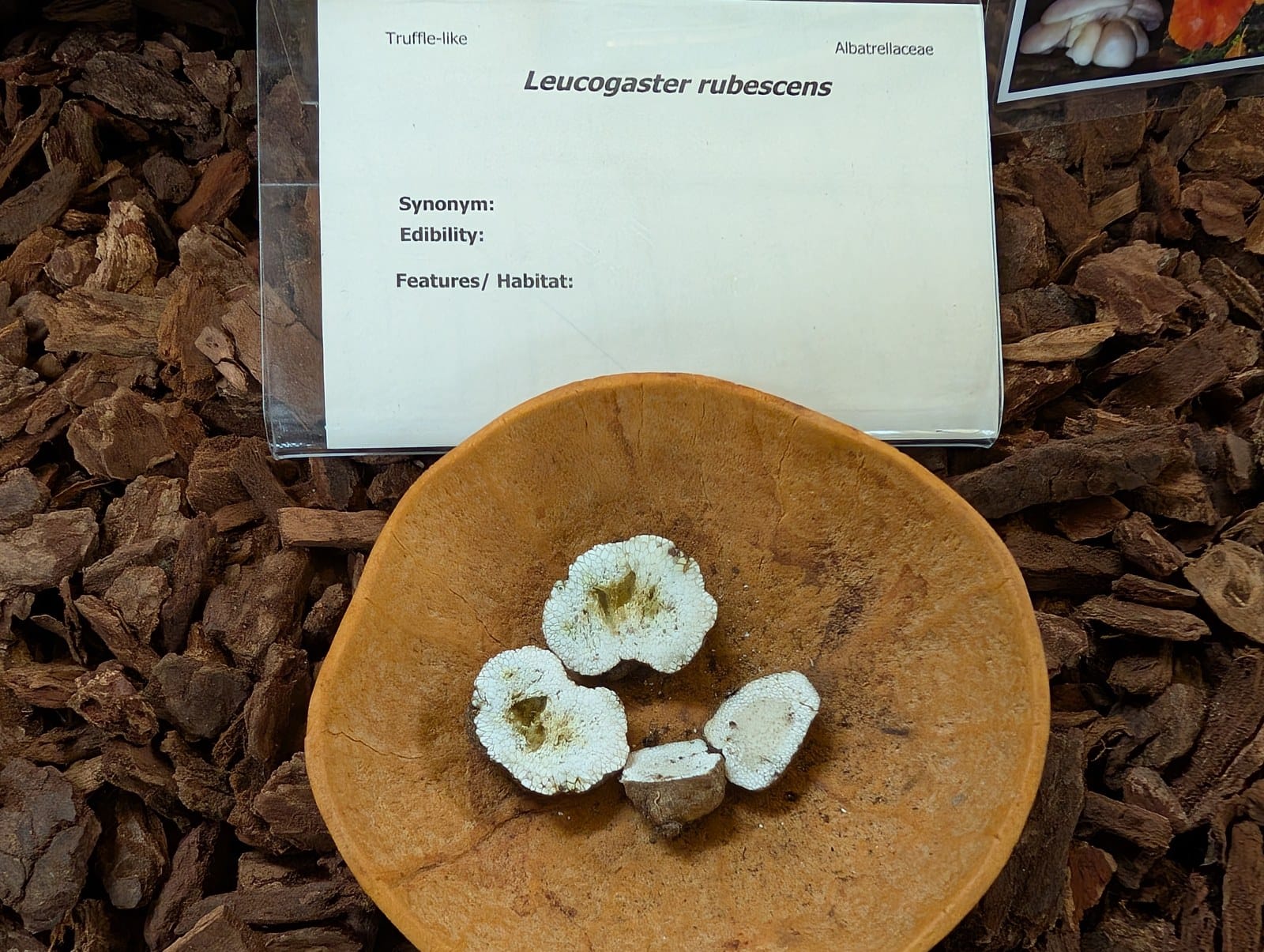
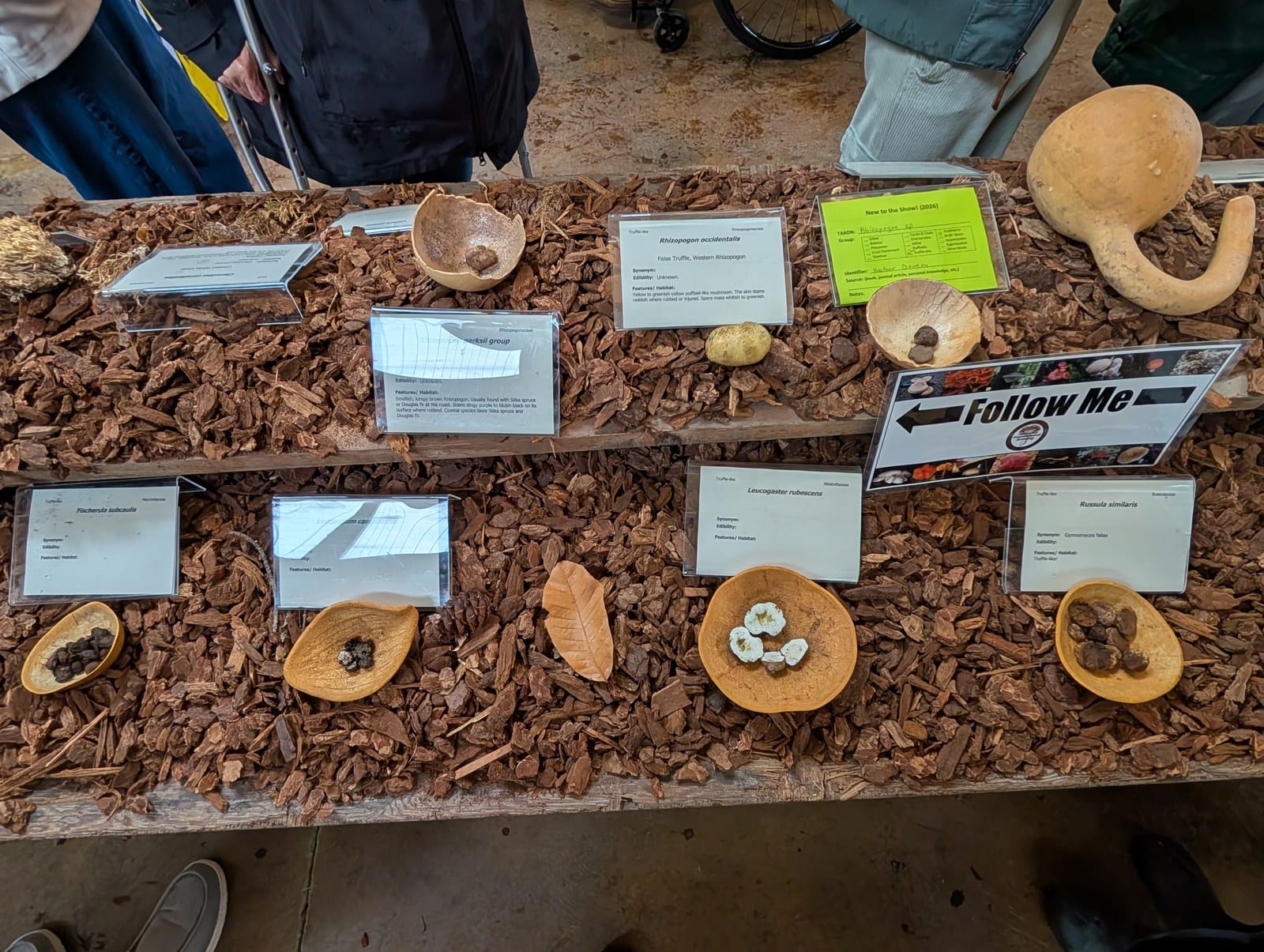
Cut specimens displayed beneath a Leucogaster rubescens label. An overview of the truffle-like fungi display.
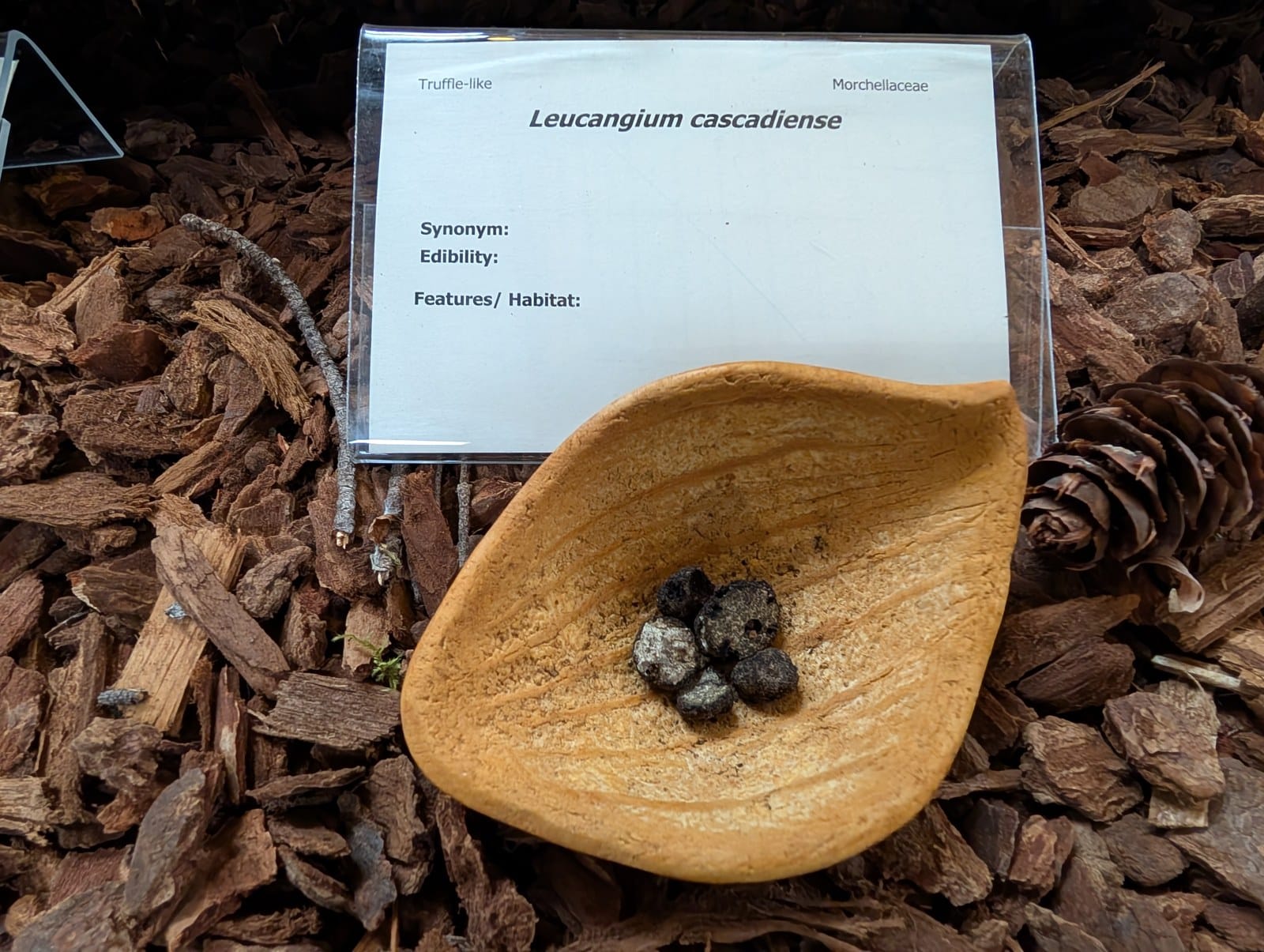
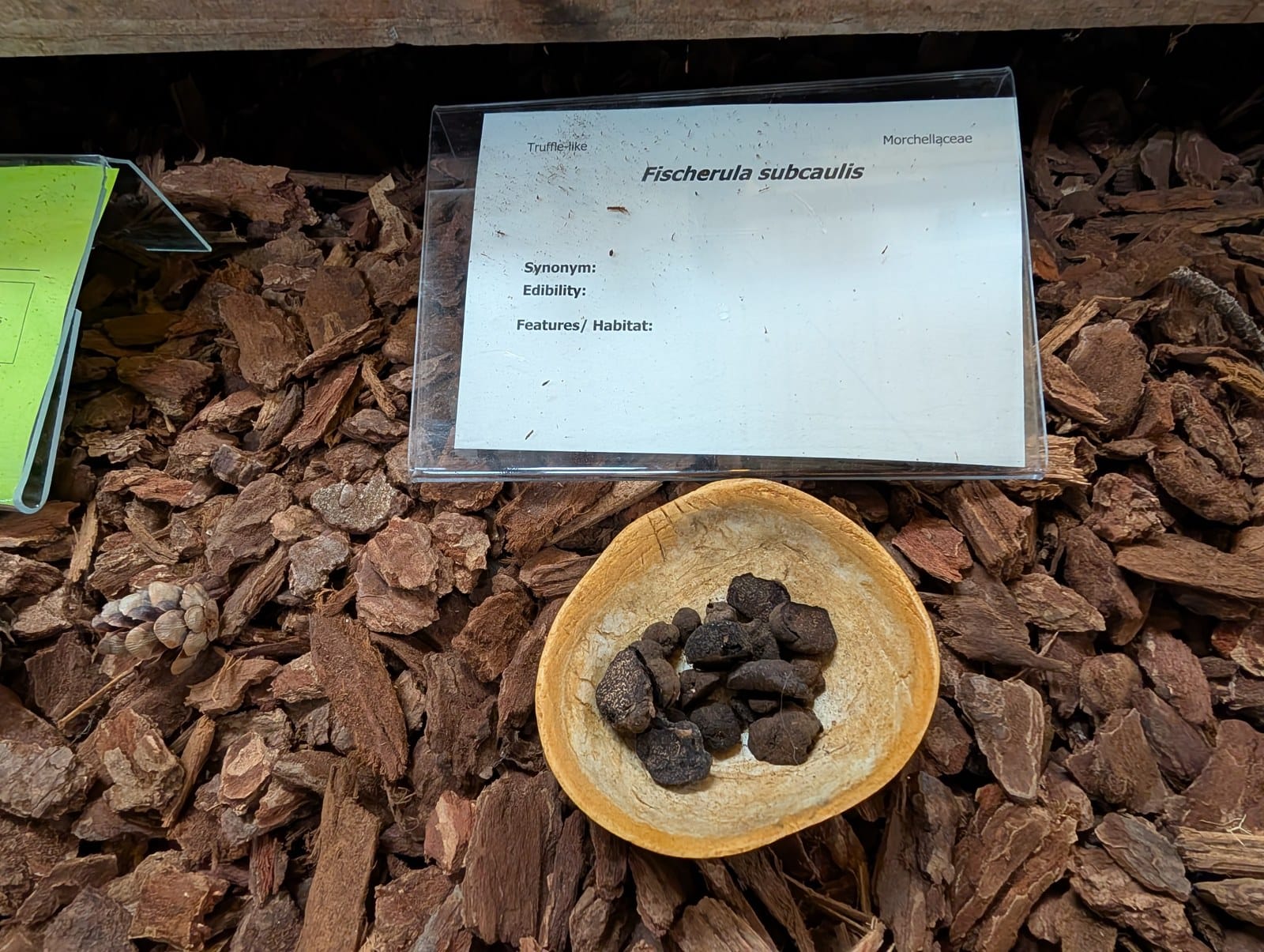
Leucangium cascadiense and Fischerula subcaulis
Outside of the mushroom ID display room, there were two tables with presentations from truffle groups. At the Oregon Truffle Festival table, there was a blind smell-test with five samples: three expensive European truffles and two native Oregon varieties. My favorite was the Oregon white truffle, and it was also the most popular one among festival participants.
The Oregon Truffle Festival celebrates the culinary art, sport, and cultural impact of native truffles in western Oregon. The event combines truffle dog competitions and training with cultivation education, forays, and a fresh-truffle marketplace.
Upcoming 2027 dates include the Joriad North American Truffle Dog Championship in Eugene on February 5 and training on February 6 and 7. McMinnville hosts forest-to-table dining and farming events from February 19 to 21, followed by a gala dinner at The Ritz-Carlton in Portland on February 27 and the Oregon Fresh Truffle Marketplace there on February 28.
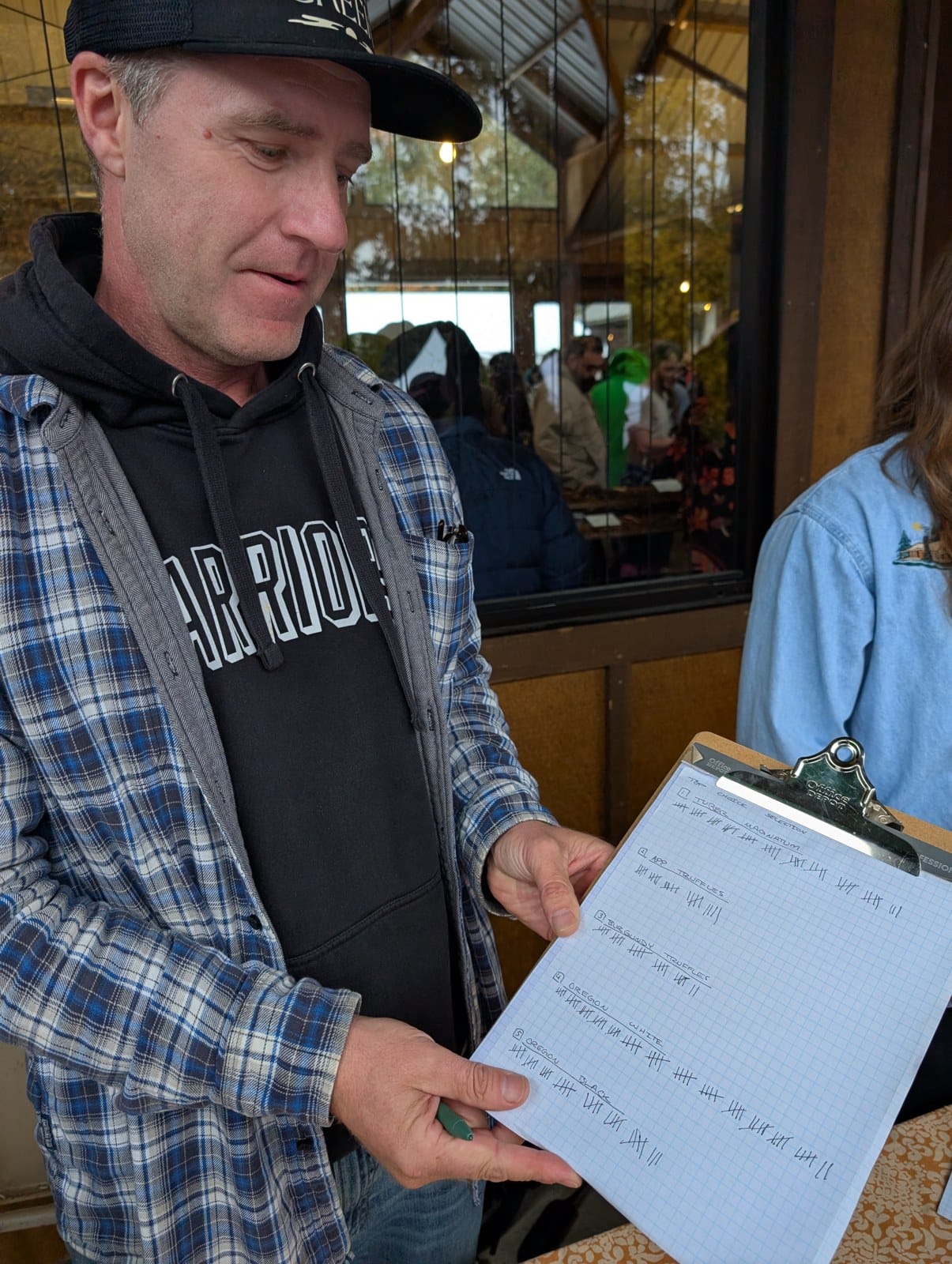
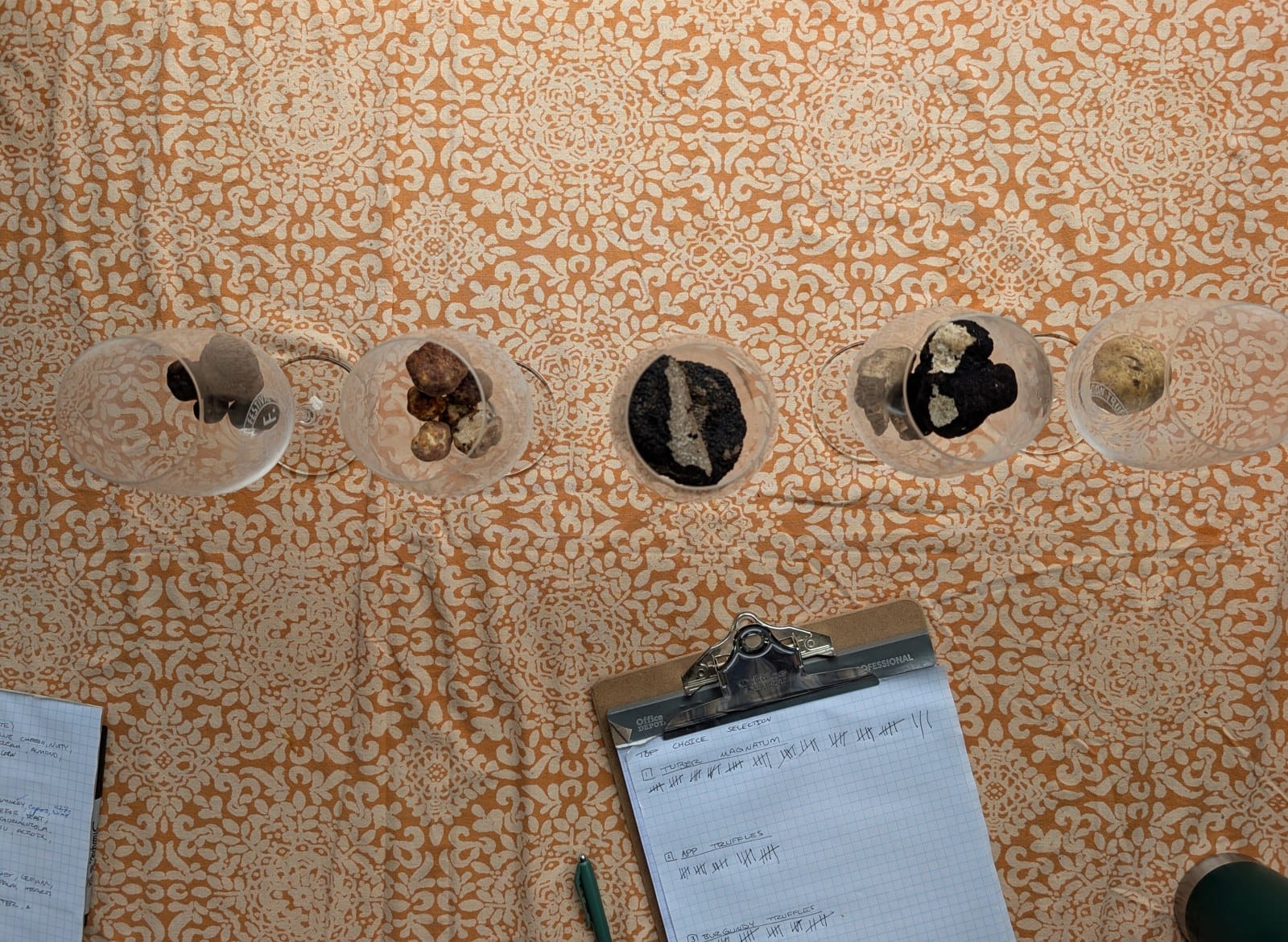
The clipboard used to tally visitors' favorite truffle aromas. The blind smell-test samples and preference tally sheet.
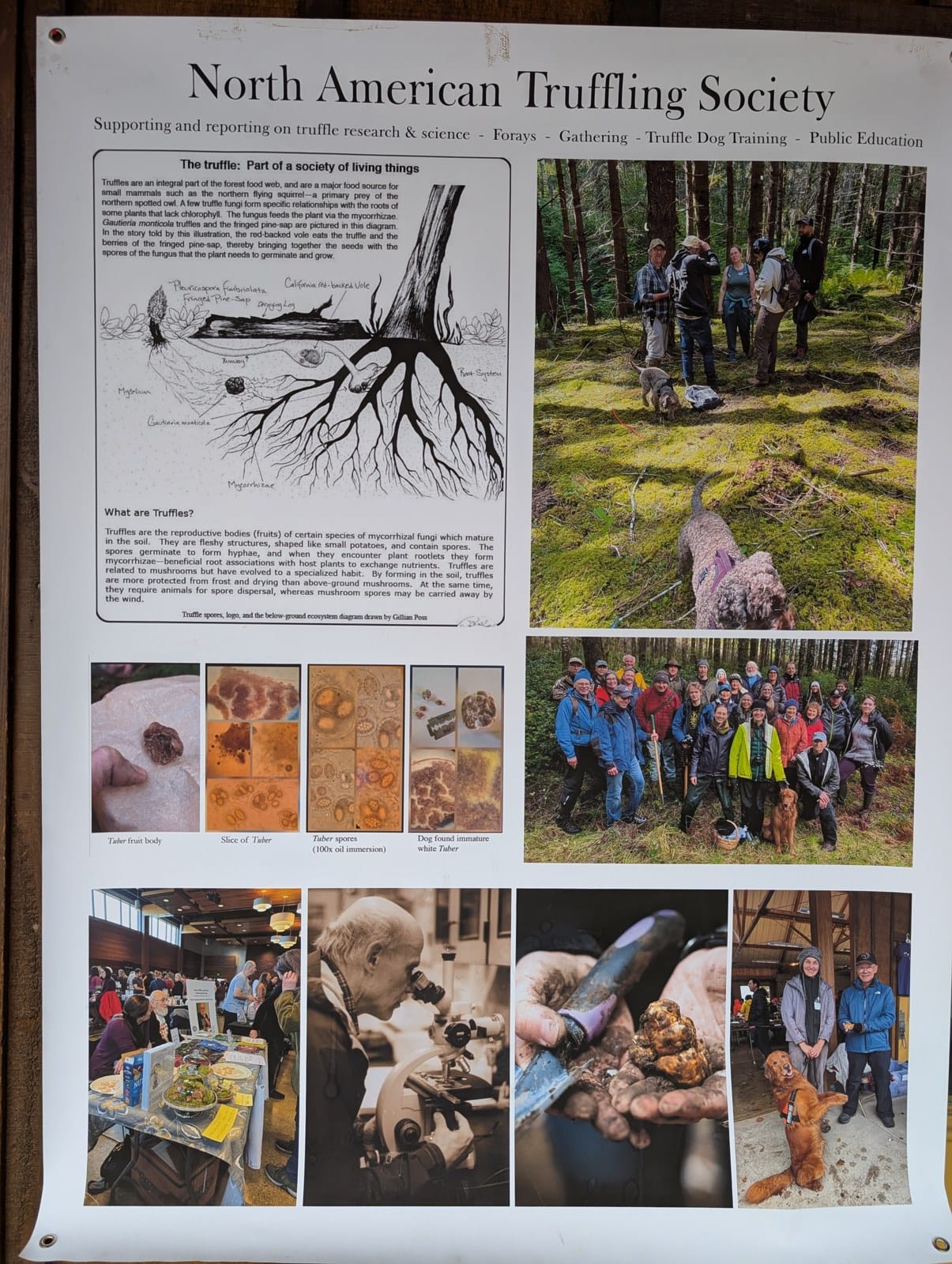
The North American Truffling Society also had an exhibit. Founded in 1978 and based in Corvallis, Oregon, the North American Truffling Society is a nonprofit that connects professionals and amateurs interested in hypogeous fungi, which produce their fruiting bodies below ground. Its mission is to advance education and scientific knowledge about North American truffles and truffle-like fungi. The society has regular speaker meetings and members are invited to attend truffling forays.
Sarah Colby, owner of Truffle Connection PNW, was one of the attendees at the NATS exhibit. She provides guided truffle hunting outings with trained dogs along with native Oregon truffles and infused foods. Her work focuses on education regarding truffles and cooking while emphasizing forest stewardship and responsible harvesting. In addition to running her business, she volunteers as the event coordinator for the North American Truffling Society.
Who would have thought that foraging at a random spot on a Saturday afternoon would have led to an opportunity to volunteer at the Mount Pisgah Mushroom Festival and become more involved in the local mushroom community?
One of the things that I appreciate about the mycology community is how people of all sorts of backgrounds and experience levels are brought together. Whether they happen to be foragers, chefs, researchers, artisans, or even the animal companions that hunt truffles, they all have one thing in common: an admiration for the fabulous fruiting bodies we like to affectionately call mushrooms.
-AP